Ancient to Modern · Cycle-based
Chinese Sexagenary Cycle
The sexagenary system names years and other time units through repeating stem-branch combinations. It is related to, but distinct from, the 12-animal zodiac cycle.

What is the Chinese Sexagenary Cycle?
The sexagenary system names years and other time units through repeating stem-branch combinations. It is related to, but distinct from, the 12-animal zodiac cycle.
How the calendar is structured
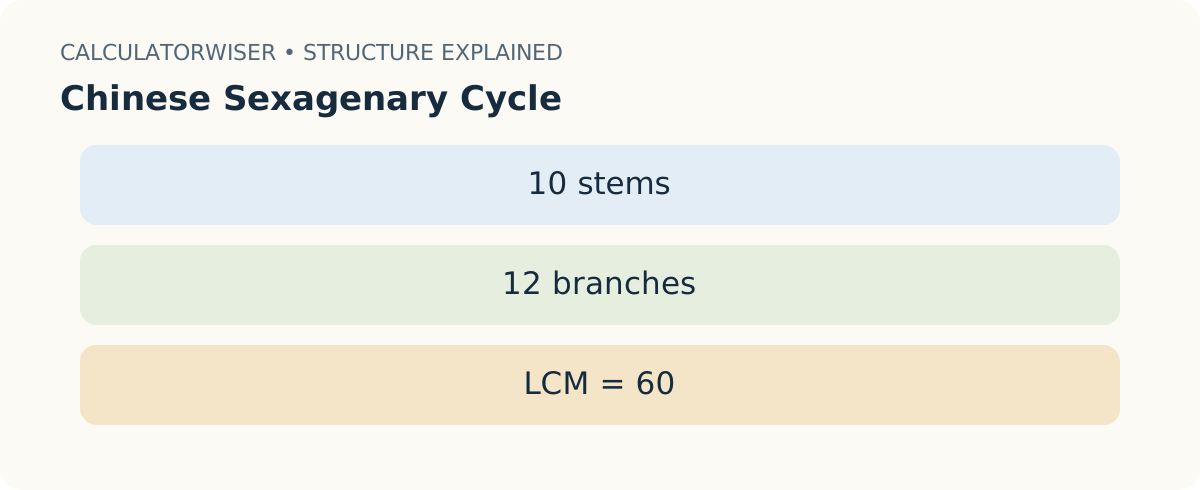
60-unit cycle created by combining 10 Heavenly Stems and 12 Earthly Branches.
60-unit cycle created by combining 10 Heavenly Stems and 12 Earthly Branches.
Where and why it is used
Region: East Asia. Primary context: Traditional year/day naming and historical chronology.
History and development
The system belongs to the Ancient to Modern layer of the archive. Its origin is summarized as Ancient. CalculatorWiser separates historical reconstruction, religious observance, civil use, and modern technical standards so different systems are not treated as though they all work the same way.
Visual reference gallery


Conversion and accuracy notes
Some calendar systems can be converted deterministically with modern algorithms. Others depend on observation, local authority, historical reconstruction, or regional practice. CalculatorWiser marks those distinctions rather than presenting uncertain dates as exact.
Research trail
This entry is part of the research-backed World Calendar Archive. Primary research anchor for this entry: Chinese calendar references.
Related calendar systems
Explore the history in depth
Ancient to Modern · Naming cycle
Chinese Sexagenary Cycle
Ten heavenly stems and twelve earthly branches combine into a recurring sixty-step sequence.
History and people
The Gan-Zhi cycle has named years for more than two thousand years. The Hong Kong Observatory discusses why an apparently simple question about the year can depend on which year-boundary convention is being used.
How the system works
The stem and branch both advance one step at a time. Because ten and twelve share a factor of two, the simultaneous sequence has sixty combinations, not all 120 mathematically possible pairings.
Worked example
The least common multiple of 10 and 12 is 60. After sixty steps, both counters return together to their starting points. This is a naming cycle rather than an extra sixty-year astronomical orbit.
What to watch for
Write down the boundary convention when interpreting an early-year birth date or historical year label. Lunar New Year and Spring Commences can fall on different dates.
Save to Pinterest