Ancient to Modern · Lunisolar
Hebrew / Jewish Calendar
The fixed Hebrew calendar coordinates lunar months with the solar year. Rules for postponements and variable month lengths make it more sophisticated than a simple 19-year leap-month table.

What is the Hebrew / Jewish Calendar?
The fixed Hebrew calendar coordinates lunar months with the solar year. Rules for postponements and variable month lengths make it more sophisticated than a simple 19-year leap-month table.
How the calendar is structured
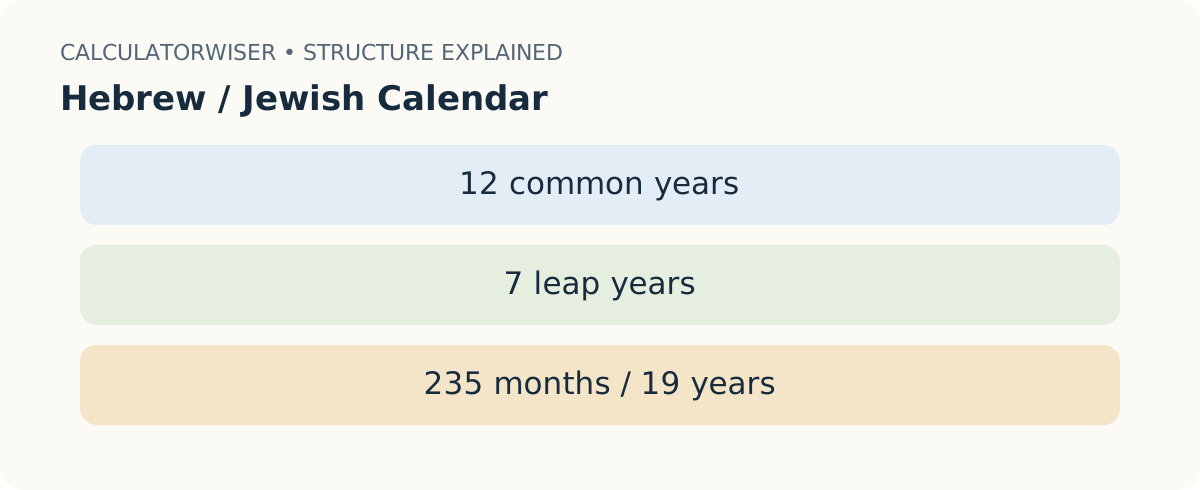
12 or 13 months; leap months in 7 years of a 19-year cycle.
12 or 13 months; leap months in 7 years of a 19-year cycle.
Where and why it is used
Region: Jewish communities worldwide. Primary context: Jewish holidays, religious observance, lifecycle dates and traditional chronology.
History and development
The system belongs to the Ancient to Modern layer of the archive. Its origin is summarized as Ancient roots; later fixed calculated form. CalculatorWiser separates historical reconstruction, religious observance, civil use, and modern technical standards so different systems are not treated as though they all work the same way.
Visual reference gallery


Conversion and accuracy notes
Some calendar systems can be converted deterministically with modern algorithms. Others depend on observation, local authority, historical reconstruction, or regional practice. CalculatorWiser marks those distinctions rather than presenting uncertain dates as exact.
Research trail
This entry is part of the research-backed World Calendar Archive. Primary research anchor for this entry: Jewish calendar references.
Related calendar systems
Explore the history in depth
Ancient to Modern · Lunisolar
Hebrew / Jewish Calendar
Calculated lunar months are kept near the seasons through a recurring pattern of additional months.
History and people
Older practice relied on lunar observation. The later calculated calendar uses a nineteen-year framework alongside rules governing the beginning and length of the year.
How the system works
Twelve of the nineteen years have twelve months and seven have thirteen. Leap years occupy positions 3, 6, 8, 11, 14, 17 and 19. Postponement rules and variable month lengths mean ordinary years can have 353, 354 or 355 days; leap years 383, 384 or 385.
Worked example
Twelve common years contribute 144 months; seven leap years contribute 91. Together they give 235 months in nineteen years. The inserted month preserves the relationship between lunar dates and the seasonal year.
What to watch for
An extra Hebrew month is not the same mechanism as February 29. A simple Gregorian year offset does not fully convert the date; the month and year boundary matter.
Save to Pinterest