Modern Scientific · Continuous day count
Julian Day / Julian Date
Julian Date is not the same thing as the Julian calendar. Astronomers use it as a continuous numerical time variable; at 0h UT1, the Julian Date ends in .5.

What is the Julian Day / Julian Date?
Julian Date is not the same thing as the Julian calendar. Astronomers use it as a continuous numerical time variable; at 0h UT1, the Julian Date ends in .5.
How the calendar is structured
Continuous count of days and fractions from a remote epoch.
Continuous count of days and fractions from a remote epoch.
Where and why it is used
Region: Astronomy worldwide. Primary context: Astronomy, ephemerides, scientific software and chronology.
History and development
The system belongs to the Modern Scientific layer of the archive. Its origin is summarized as Chronological system introduced in early modern astronomy. CalculatorWiser separates historical reconstruction, religious observance, civil use, and modern technical standards so different systems are not treated as though they all work the same way.
Visual reference gallery


Conversion and accuracy notes
Some calendar systems can be converted deterministically with modern algorithms. Others depend on observation, local authority, historical reconstruction, or regional practice. CalculatorWiser marks those distinctions rather than presenting uncertain dates as exact.
Research trail
This entry is part of the research-backed World Calendar Archive. Primary research anchor for this entry: U.S. Naval Observatory.
Related calendar systems
Explore the history in depth
Modern Scientific · Continuous day count
Julian Day / Julian Date
Astronomers can compare events using a continuous numerical count instead of a calendar’s month names.
History and people
Julian Date counts days and fractions from a conventional epoch at noon Universal Time on 1 January 4713 BCE in the Julian calendar. The noon boundary helps distinguish it from ordinary civil dates.
How the system works
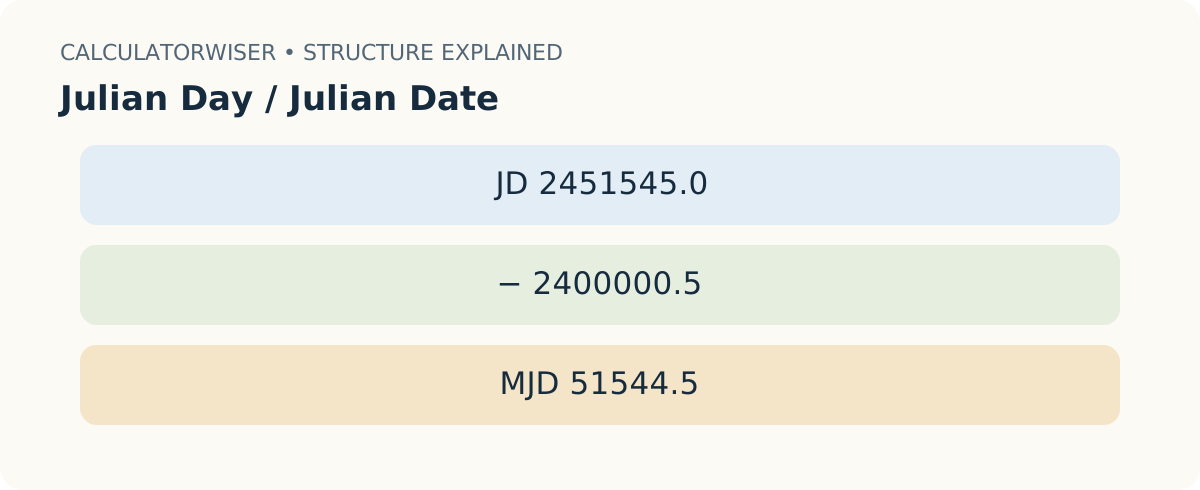
Whole units represent days; fractions represent parts of a day. Modified Julian Date subtracts 2,400,000.5, giving smaller values and a midnight rather than noon boundary.
Worked example
At 12:00 UT on 1 January 2000, JD is 2,451,545.0. Subtracting 2,400,000.5 gives MJD 51,544.5. At midnight at the beginning of that day, the values are JD 2,451,544.5 and MJD 51,544.0.
What to watch for
The Julian calendar and Julian Date are different concepts. Include the time and time scale when precision matters: a date-only input cannot identify a unique fractional day.
Save to Pinterest