CalculatorWiser / Forgotten technology
Legacy Repair Workshop
Understand the fault. Preserve the evidence. Restore with a plan.
Progress can be saved in this browser when JavaScript and local storage are available.
Vintage RC Controls & Brushed Drive Systems / Lesson 4 of 6
Older reversible ESC: no reverse is not automatically a failed bridge
Understand the system
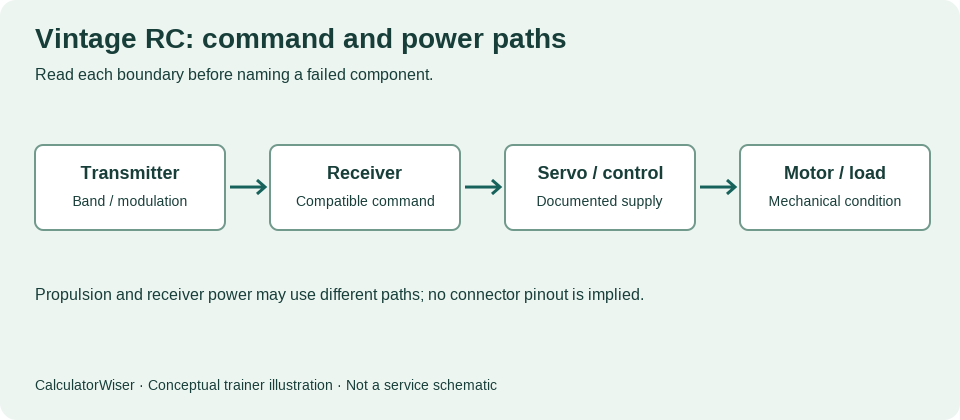
Legacy reversible brushed ESCs differ in neutral calibration, braking sequence, reverse behavior and motor limits. Some require a return to neutral before reverse, while other modes disable reverse. A no-reverse complaint can come from setup, radio endpoints, a command-link problem or hardware. A symptom does not by itself identify a MOSFET.
Diagnostic method
Identify the exact controller and read its original operating instructions before any settings change. Record motor compatibility, battery chemistry/range, receiver-power arrangement and existing calibration. Do not copy a calibration sequence from a different model. All bench work must prevent propulsion: disconnect the motor or use the manufacturer's approved restrained setup under qualified supervision. Do not bridge outputs, bypass current sensing or probe a live bridge as a beginner.
Case study: read the evidence
A recorded test says forward and steering work, but reverse does not. The transmitter throttle trim was changed after the last successful run, and no controller settings were recorded.
Reveal the diagnostic reasoning
The changed trim is a plausible neutral-recognition issue to investigate before hardware. Confirm the controller's supported modes and documented calibration. If compatible commands and settings are verified and the fault remains, a qualified technician can investigate hardware. A partial H-bridge failure is a possibility, not a conclusion.
Your practical or paper exercise
Produce an external-check decision tree: supported reverse mode, unchanged transmitter settings, documented neutral/calibration, receiver command, then qualified hardware assessment.
Notes stay in this browser. They are not submitted to CalculatorWiser.
Compare with the worked answer
The tree should distinguish a designed behavior from a defect and preserve the original settings before a reset. It must not contain a universal button sequence.
Repair evidence worksheet
For this case, record: equipment identity; exact symptom; expected behavior and source of that expectation; competing causes; evidence for and against each; next safe step; qualified-service needs; parts justification; acceptance criteria and remaining unknowns.
References and original manuals
Lessons and fictional cases are original. These links provide further reading, not permission to copy or resell manuals. A manual for another chassis or controller is not a substitute for the installed model’s service documents. Historic procedures may not meet present safety practice. No external document loads automatically.
Guardar en Pinterest