From ancient records to computer time
Illustrated Calendar Histories
Explore 17 expanded guides, with worked examples, museum objects and direct links to research sources.
Introduction to calendars: counting time, shaping history
A calendar assigns names and numbers to days. An almanac puts useful information beside those dates: observations, reminders, seasonal notes and records. Build yours below or explore the illustrated histories to see how different societies organized time.
Deep dive: Sun, Moon and the problem of fitting cycles together
A day follows Earth’s rotation; a seasonal year follows its orbit; a lunar month follows the cycle of lunar phases. These cycles do not fit into whole numbers. Solar calendars keep dates aligned with the seasons. Lunar calendars follow lunar months. Lunisolar calendars reconcile both by inserting extra months according to their rules.
Leap days and leap months are different solutions. A calendar can be calculated from rules or depend on observations. Consequently, two communities may assign different dates to the same event. Record the calendar, place and convention when interpreting a historical date.
Deep dive: why calendar reforms changed date labels
The Julian rule adds a leap day every four years. The Gregorian rule keeps that pattern but excludes century years unless divisible by 400. Thus 1900 is a Gregorian common year, while 2000 is a leap year. The Gregorian 400-year cycle contains 97 leap years: (400 × 365 + 97) ÷ 400 = 365.2425 days.
In the initial 1582 reform, Thursday 4 October in the Julian calendar was followed by Friday 15 October in the Gregorian calendar. The dates jumped; the sequence of days continued. Other regions adopted the reform later. Applying modern Gregorian rules backward is called a proleptic calendar; it does not reproduce every country’s historical civil dates.
Leap-year rules · The 1582 transition and continuous day counts
Deep dive: an almanac as a personal record
Almanacs combine calendars with information selected for their readers. Library of Congress collections include French-American examples with revolutionary calendars and later publications focused on everyday community interests. Their contents reveal what mattered to the people who used them.
Make your own record of birthdays, work, family, garden observations or study. Date an observation, record its location and distinguish what you observed from what you predicted. Over successive years, your almanac becomes a history you can compare.
Library of Congress: French-American Almanacs · Poor Richard’s almanac collection record
Build Your Own Almanac — open the creator
Your dates · Your stories · Your year
Build Your Own Almanac
Create a personal almanac book with a cover, calendar pages, recurring events, monthly journals, your own chapters and illustrated history. Save a draft on this device, download a backup, or print and choose Save as PDF.
The almanac maker’s field guide
Build a book you can use all year
Start with a title, year and location label. Choose one month to experiment, a month range for a season, or a complete year. Add birthdays as MM-DD entries so your backup can be reused with a new year. Dated YYYY-MM-DD entries belong to the selected year and must be updated when you change it.
Write monthly entries as the year unfolds. Use custom chapters for a family story, project record, garden inventory or calendar research. Download a backup before editing a new year. Give each saved edition a distinct title; saving the same title and year updates that draft.
Keep a garden, weather or nature journal
Use the garden template to record your own observations: date, location, plant or variety, conditions, action taken and outcome. A useful entry might read “April 12: first tomato flowers; bed 2; watered after dry soil check.” Follow the same format through the season so you can compare what happened.
Record actual rainfall, temperatures or first blooms from your observations or a named local source. Meteorological seasons are broad three-month labels, not a forecast or a planting schedule. Local climate, frost, soil and crop requirements determine practical timing. Keep folklore in a separate chapter with its source.
Read the Moon guide
The Moon’s phase cycle averages about 29.5 days. New, first quarter, full and last quarter are stages of changing illumination. This builder uses a repeating mean cycle of 29.53059 days anchored to NASA’s listed new Moon of January 6, 2000, 18:14 UT. Each daily label is evaluated at noon UTC.
This simple teaching model estimates a phase category; it does not calculate precise phase times, moonrise, moonset, eclipses or local visibility. The true cycle varies. Use the U.S. Naval Observatory’s phase tables for precise dates.
USNO: phases and illumination · Primary phase dates · NASA: historical phase table
Turn observations into history
A personal almanac connects a date to a record of life. Library of Congress conservation notes describe George Washington’s pocket diaries as records of activities and observations, including weather and agriculture. Your almanac can likewise preserve everyday details that are easy to forget.
Separate a contemporary observation from a later recollection. Record who supplied a story, when you wrote it down and which calendar a historical date uses. For calendar study, add a history chapter and use your personal chapters to compare its rules with your own Gregorian pages.
Save, reuse and export
Named drafts stay in the browser used to save them. JSON backups include your settings, journals, events and chapters, and can be restored in this builder on another device. Your earlier v1.1 backups are supported.
CSV contains the event dates and titles for the months in your edition. Calendar export creates all-day events for the chosen year; annual entries become dates in that year, not indefinite repeating reminders. Import the .ics file using your calendar app’s import option. Printing produces the cover, monthly pages, journals, selected history, personal chapters and this guide.
Annual February 29 entries are omitted in common years and identified in the builder’s status message. They are not moved to another date.
A personal almanac for a connected world
Dates, languages and conventions
Gregorian pages provide the organizing grid. Your date-language selection changes month and weekday names. The editor and learning text remain English. An optional reference calendar adds a second label to each day using your browser’s calendar implementation; unsupported calendars produce a clear message rather than quietly using Gregorian dates.
The reference label is evaluated at noon UTC. It does not implement a sunset day boundary, a location-specific Hindu panchang, a religious authority’s moon-sighting decision, or every historical civil adoption. Record the specific convention alongside dates used for research.
Regional almanacs: what can differ?
Hong Kong Observatory publishes Gregorian-lunar conversion tables. Drik Panchang offers Hindu almanacs with location-based festivals. Hebcal allows customized Jewish calendars and calendar-app exports. These sources show why a cultural calendar is more than a translated month name.
Local seasons belong to local places
Australia’s Bureau of Meteorology hosts seasonal calendars from Aboriginal and Torres Strait Islander communities. They are place- and community-specific records of seasonal knowledge. A four-season label is not a complete description of all climates.
Use local season labels for your own observations, such as wet or dry periods, without presenting them as a traditional community calendar. For a named tradition, link to its community-approved source and distinguish your observations from that tradition.
International holidays and personal anniversaries
For regional holidays, use an official calendar for the country, region and year. Add confirmed dates through the event editor or import a Date,Event CSV. Keep the source and date checked in your observation sources. Annual Gregorian birthdays can use MM-DD; cultural-calendar anniversaries need conversion for each edition rather than fixed Gregorian recurrence.
A rolling edition starts in your chosen month and continues for twelve months. Monthly events on the 29th, 30th or 31st skip months without that date. Calendar-app exports contain the occurrences shown in the selected edition.
Ancient · Solar
Ancient Egyptian Civil Calendar
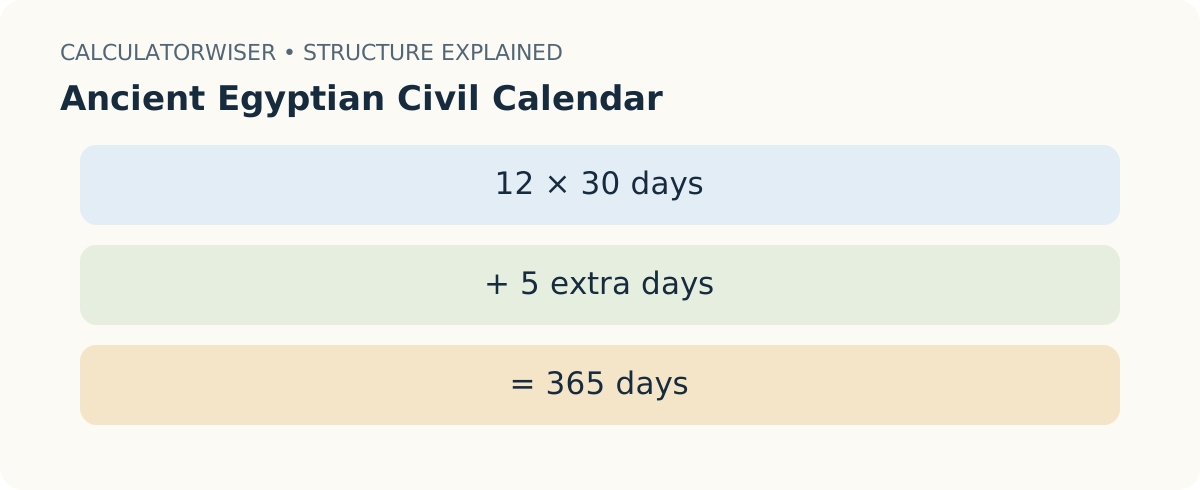
Twelve regular months and five additional days gave Egyptian administrators a predictable 365-day framework.
History and people
By at least about 2450 BCE, Egypt had a civil calendar divided into Akhet, Peret and Shemu: inundation, emergence and harvest. Dates identified a day, month and season, usually alongside a ruler’s regnal year. The Nile and the reappearance of Sirius supplied important seasonal context, but the civil calendar was a separate counting system.
How the system works
Each season contained four 30-day months. Five epagomenal days stood outside those months. Without a regular leap day, the civil year gradually moved relative to the seasonal year.
Worked example
Twelve times 30 equals 360; adding five gives 365. Relative to a simplified 365.25-day year, the shortfall accumulates to about one day in four years. This arithmetic explains drift; it does not establish an exact ancient founding date.
What to watch for
The three season names do not prove that every civil date matched the Nile’s actual seasonal conditions. Reconstructing a date also requires the reign and the chronology being used.
About this object
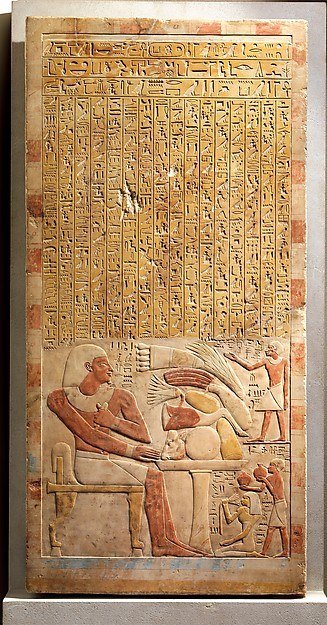
Historical context: an Egyptian inscribed stela from the reign of Senwosret I; not a printed calendar.The Metropolitan Museum of Art · Gift of Edward S. Harkness, 1912 · Public domain / Open Access · Object recordAncient · Lunisolar
Babylonian Calendar
Mesopotamian timekeeping brought lunar months, seasonal needs and detailed astronomical records together.
History and people
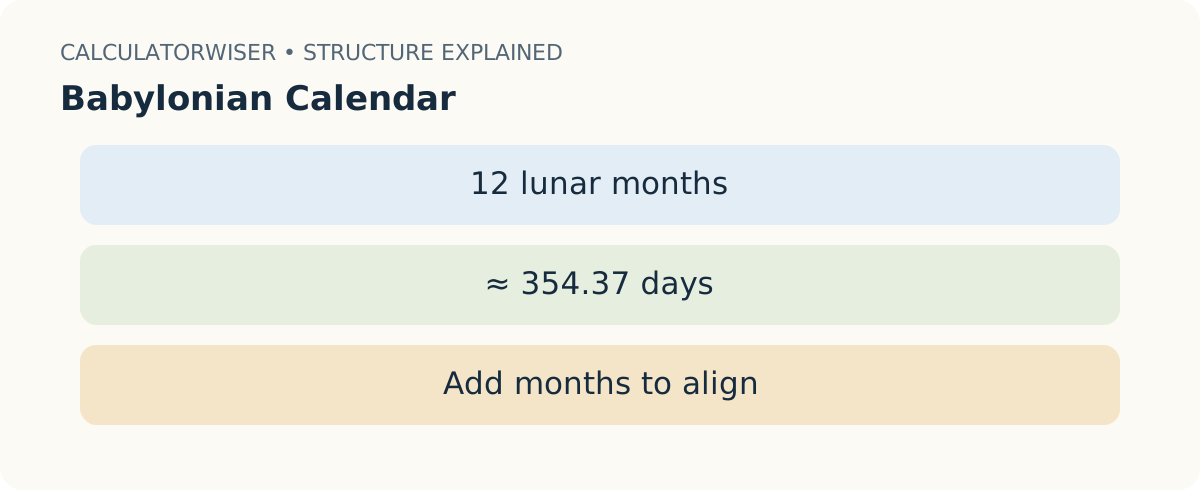
Astronomical tablets show the sophistication of Babylonian lunar calculations. British Museum tablet 55555 preserves numerical values for the mean synodic month and a year, illustrating the mathematical study behind ancient time reckoning.
How the system works
Lunar months alone do not fill a seasonal year. Intercalation—adding a month—can keep a lunar sequence near the seasonal cycle. This is the central problem faced by lunisolar calendar makers.
Worked example
Using the tablet’s mean month of 29.530594 days, twelve months total approximately 354.367 days. Compared with a 365.24-day seasonal year, that leaves roughly 10.87 days. An extra month addresses accumulated difference, rather than changing every month into a solar month.
What to watch for
A surviving procedure tablet is evidence of astronomical mathematics, not a universal rulebook for every Mesopotamian place and century. Historical reconstruction must identify the period and surviving records.
Classical · Solar
Julian Calendar
A straightforward leap-day rule improved Roman civil timekeeping, but accumulated seasonal drift over centuries.
History and people
Julius Caesar introduced the Julian reform in 45 BCE. Its familiar rule adds a leap day every fourth year. A solar calendar can make administration easier because its year aims to follow the seasons instead of the changing Moon.
How the system works
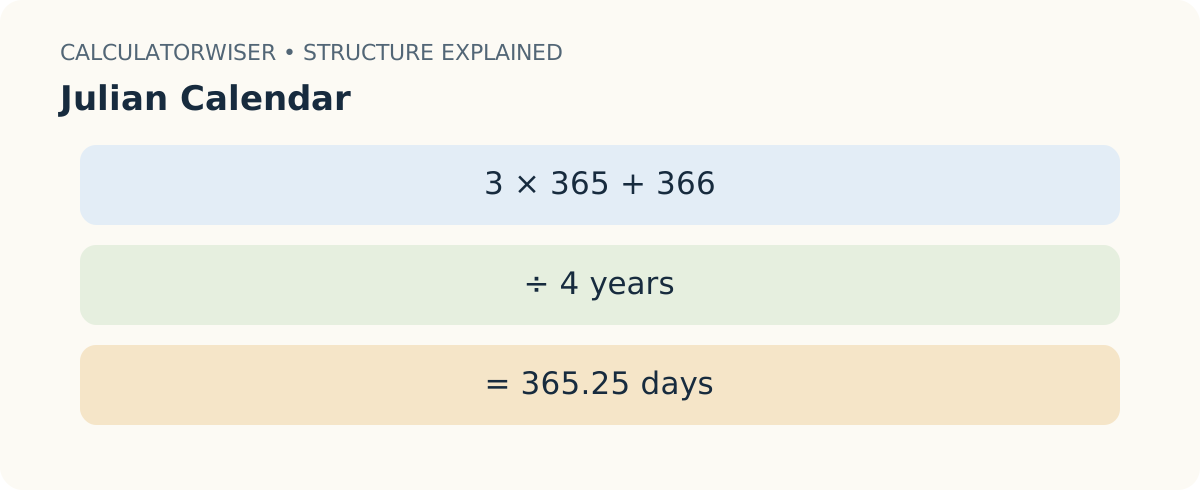
Three 365-day years and one 366-day year average 365.25 days. That is slightly longer than the tropical year, so a small annual mismatch eventually becomes a visible calendar shift.
Worked example
Across four years: 365 + 365 + 365 + 366 = 1,461 days. Dividing by four gives 365.25. Gregorian century exceptions later reduced the average to 365.2425 days.
What to watch for
Do not confuse the Julian calendar with Julian Date, an astronomical day count. Nor should one fixed day offset be applied across all centuries: the two calendars’ leap rules differ.
Ancient to Modern · Ritual cycle
Maya Tzolkʼin
A 260-day count pairs a repeating number with a repeating day name; it is a living tradition, not simply an ancient curiosity.

History and people
Maya daykeeping connects time to community, ceremony and the natural world. Smithsonian’s Living Maya Time presents contemporary Maya perspectives and the connections between the sacred count, agriculture and the Sun.
How the system works
Thirteen numbers progress together with twenty day names. Both advance daily. Since 13 and 20 have no common factor, an identical pair returns after 260 days.
Worked example
An abstract sequence begins 1/A, 2/B, and continues. After 13/M comes 1/N: the number wraps while the names continue. After twenty days the names wrap, but the numbers have moved on. The complete combination repeats after 13 × 20 days.
What to watch for
The 260-day count is not a twelve-month solar year. Interpretations and names vary among Maya languages and communities. Respect living daykeepers’ knowledge rather than treating all Maya practice as one extinct system.

About this object
Cultural context: a Maya ceramic vessel. This photograph is not a diagram of the Tzolkʼin.The Metropolitan Museum of Art · The Michael C. Rockefeller Memorial Collection, Gift of Nelson A. Rockefeller, 1963 · Public domain / Open Access · Object recordAncient to Modern · 365-day cycle
Maya Haabʼ
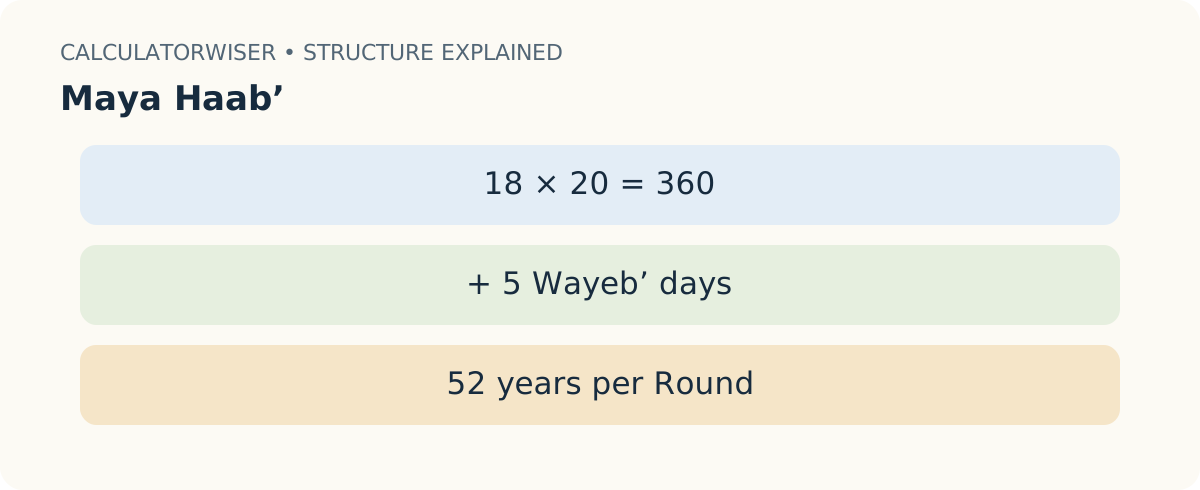
Eighteen twenty-day months followed by five Wayebʼ days form the Haabʼ annual cycle.
History and people
The Haabʼ is one part of a broader Maya calendar tradition. Smithsonian describes its continuing role in offerings and ceremonies, including special observances during Wayebʼ in Guatemala’s highlands.
How the system works
The regular months supply 360 days; the five-day period completes 365. Used with the 260-day sacred count, it creates the repeating Calendar Round.
Worked example
The least common multiple of 260 and 365 is 18,980 days: 73 sacred cycles or 52 Haabʼ cycles. Thus an identical combination in these two counts returns after 52 Haabʼ years.
What to watch for
The 52-year Calendar Round is not the Long Count. A Haabʼ date alone repeats annually and does not uniquely identify an event across history. A complete record needs additional chronological context.
Ancient · Continuous count
Maya Long Count
The Long Count distinguishes dates beyond recurring annual and ritual cycles through positional day counting.

History and people
The Long Count provides a larger chronological framework for Maya inscriptions. The celebrated date 13.0.0.0.0 in December 2012 marked a cycle boundary, not scientific evidence of a predicted global catastrophe.
How the system works
A kʼin is one day, a winal twenty days, a tun eighteen winals or 360 days, a kʼatun twenty tuns or 7,200 days, and a bʼakʼtun twenty kʼatuns or 144,000 days. The 18-winal step is an important exception to simple base-20 counting.
Worked example
1.0.0.0.0 represents 144,000 days from the chosen starting point. 0.0.1.0.0 represents 360 days. Adding one day to 0.0.0.17.19 carries into the next tun: 0.0.1.0.0.
What to watch for
A Gregorian correspondence requires a specified correlation between the two systems. This diagram explains the units; it is not a claim that every historical correlation is identical.
Ancient · Ritual cycle
Aztec Tonalpohualli
Mexica ritual dates connected named days with numbers and with particular ceremonial meanings.

History and people
The Met’s Cihuateotl sculpture offers a concrete example: a day sign on its head identifies “1 House.” The museum connects it with one of five calendrical days associated with these figures.
How the system works
The Tonalpohualli is a 260-day ritual sequence. A number from a thirteen-step cycle pairs with a name from a twenty-step cycle. This structural relationship resembles other Mesoamerican sacred counts, while cultural meanings remain specific.
Worked example
Thirteen times twenty gives 260 distinct number-name pairings before repetition. A label such as 1 House therefore identifies a position in a recurring count, not a unique Gregorian year.
What to watch for
The sculpture is a historical object bearing a day sign, not the Sun Stone and not a complete calendar chart. Maya and Mexica traditions should be identified separately.

About this object
The Met identifies the day sign 1 House on the sculpture’s head. The front photograph does not make that inscription legible.The Metropolitan Museum of Art · Museum Purchase, 1900 · Public domain / Open Access · Object recordAncient to Modern · Lunisolar
Traditional Chinese Calendar
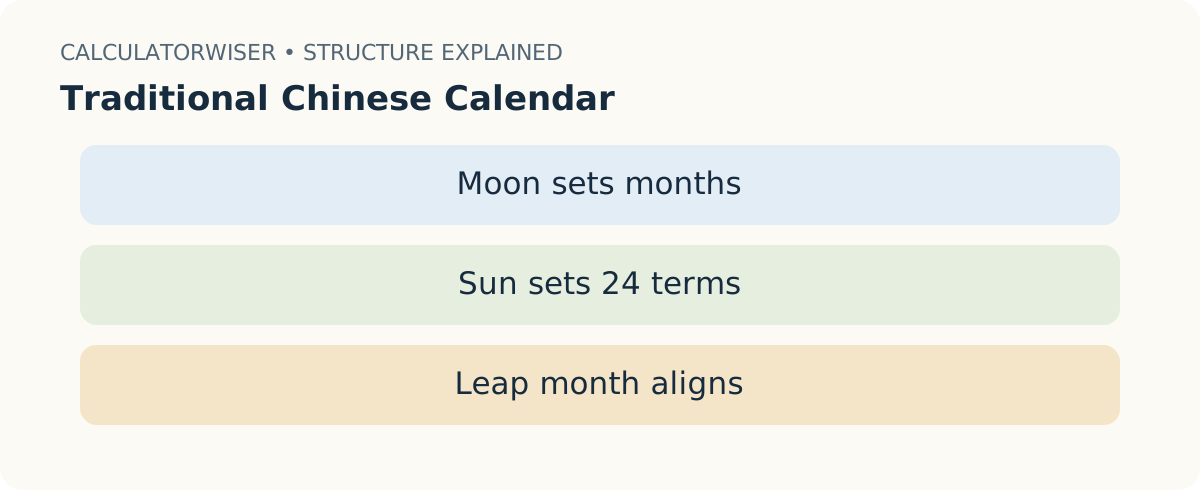
Moon-based months and Sun-based seasonal terms work together; “lunar calendar” alone misses half the system.
History and people
The Hong Kong Observatory explains the calendar through lunar months and 24 solar terms. The seasonal vocabulary reflects historical agricultural conditions in central China. Its Gan-Zhi year practice uses Lunar New Year for the changeover, while some other traditions use Spring Commences.
How the system works
Ordinary years have twelve months; leap years have thirteen. Solar terms divide the apparent Sun’s ecliptic longitude into 24 sections of 15 degrees. Major terms help determine where an additional lunar month belongs.
Worked example
360 degrees divided by 24 gives 15 degrees per term. Twelve major and twelve minor terms alternate. A leap month repeats a month designation rather than adding a permanent thirteenth named month.
What to watch for
Calendar-year labels, zodiac folklore and astronomical solar terms are related traditions, but are not interchangeable definitions. Date conversion needs the calendar’s astronomical rules and relevant time convention.
Ancient to Modern · Naming cycle
Chinese Sexagenary Cycle
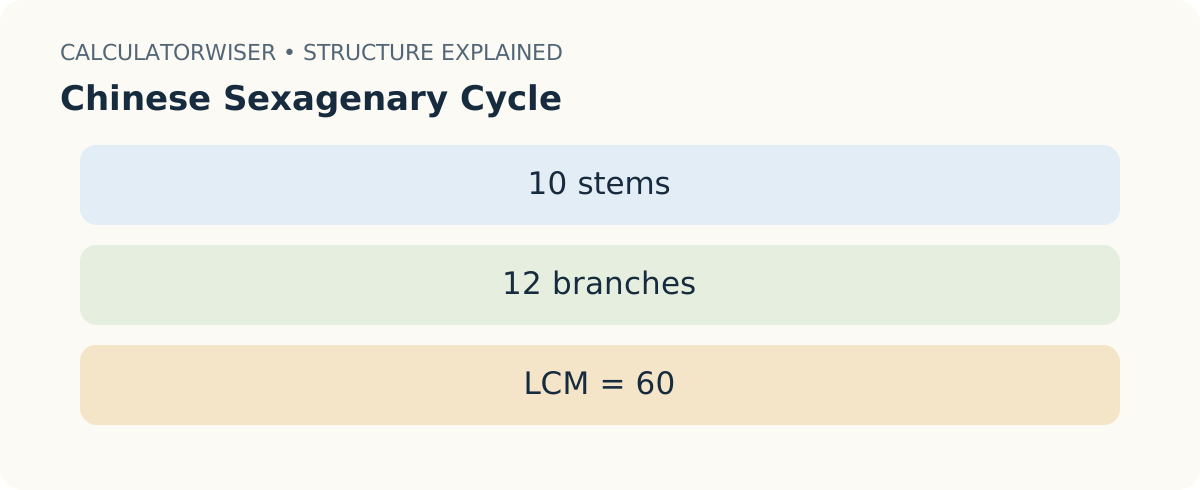
Ten heavenly stems and twelve earthly branches combine into a recurring sixty-step sequence.
History and people
The Gan-Zhi cycle has named years for more than two thousand years. The Hong Kong Observatory discusses why an apparently simple question about the year can depend on which year-boundary convention is being used.
How the system works
The stem and branch both advance one step at a time. Because ten and twelve share a factor of two, the simultaneous sequence has sixty combinations, not all 120 mathematically possible pairings.
Worked example
The least common multiple of 10 and 12 is 60. After sixty steps, both counters return together to their starting points. This is a naming cycle rather than an extra sixty-year astronomical orbit.
What to watch for
Write down the boundary convention when interpreting an early-year birth date or historical year label. Lunar New Year and Spring Commences can fall on different dates.
Ancient to Modern · Lunisolar
Hebrew / Jewish Calendar
Calculated lunar months are kept near the seasons through a recurring pattern of additional months.
History and people
Older practice relied on lunar observation. The later calculated calendar uses a nineteen-year framework alongside rules governing the beginning and length of the year.
How the system works
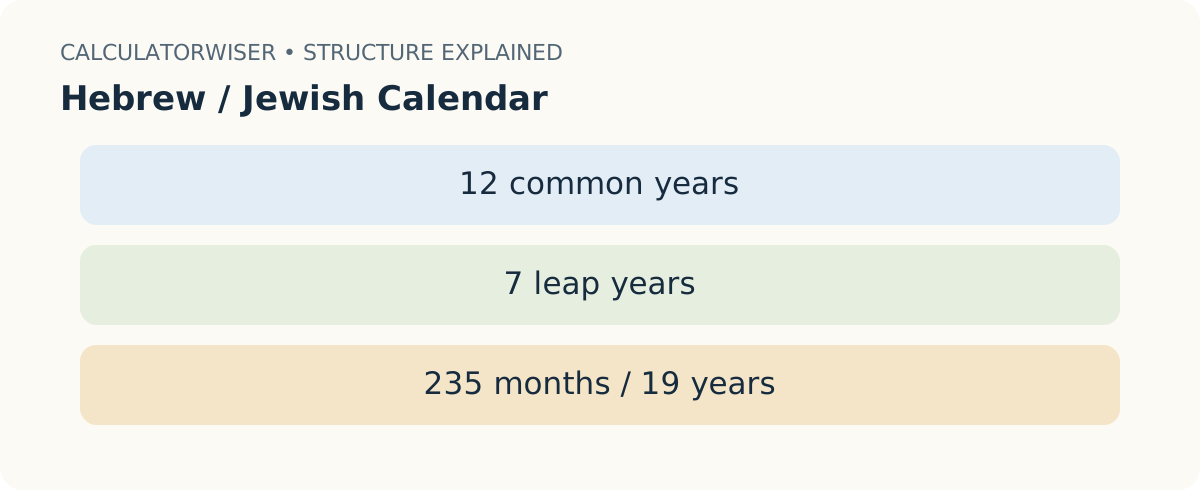
Twelve of the nineteen years have twelve months and seven have thirteen. Leap years occupy positions 3, 6, 8, 11, 14, 17 and 19. Postponement rules and variable month lengths mean ordinary years can have 353, 354 or 355 days; leap years 383, 384 or 385.
Worked example
Twelve common years contribute 144 months; seven leap years contribute 91. Together they give 235 months in nineteen years. The inserted month preserves the relationship between lunar dates and the seasonal year.
What to watch for
An extra Hebrew month is not the same mechanism as February 29. A simple Gregorian year offset does not fully convert the date; the month and year boundary matter.
Medieval to Modern · Lunar
Islamic / Hijri Calendar
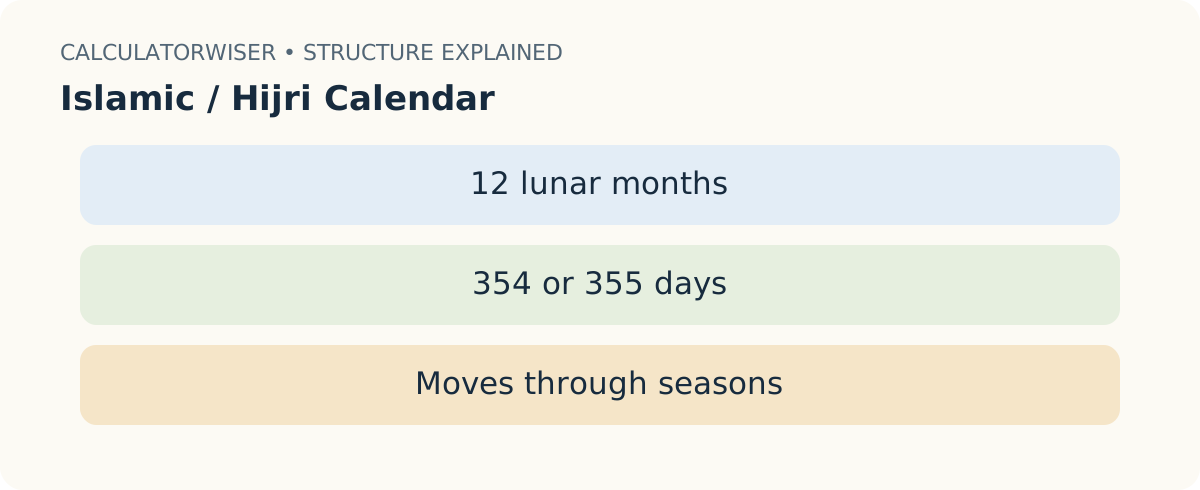
Twelve lunar months form a year that moves through the solar seasons instead of being held in one season.
History and people
The Hijri era refers to the migration associated with the early Muslim community. Traditional month beginnings depend on crescent visibility, while tabular civil systems calculate a predictable sequence.
How the system works
Twelve lunar months are roughly eleven days shorter than a Gregorian year. In one tabular form, months alternate between thirty and twenty-nine days; eleven leap years in a thirty-year cycle add a day to the final month.
Worked example
A sequence of six 30-day and six 29-day months totals 354 days. Adding a leap day gives 355. The shorter year explains why a lunar observance occurs earlier in successive Gregorian years.
What to watch for
An astronomical new moon is not the same event as first crescent visibility. Weather, location and observing conditions affect visibility. A computed civil date should not be presented as every community’s final religious decision.
Early Modern to Modern · Solar
Gregorian Calendar
The internationally used civil calendar refines the Julian leap-day rule to follow the seasonal year more closely.

History and people
The Gregorian reform was introduced in 1582. The underlying problem was the gradual drift of the Julian calendar relative to the equinox; Easter calculations were an important motivation.
How the system works
Years divisible by four are leap years, except century years unless divisible by four hundred. Thus 1900 was common, 2000 was leap and 2100 will be common.
Worked example
In four hundred years there are 97 leap days: 400 × 365 + 97 = 146,097 days. Dividing by 400 gives an average of 365.2425 days.
What to watch for
Extending Gregorian rules into dates before their local adoption is called a proleptic calculation. That is useful mathematically, but it does not mean an original historical document used those rules.

About this object
A gilt-bronze and mother-of-pearl calendar object. This is not a French Republican calendar artifact.The Metropolitan Museum of Art · Gift of Edward A. Penniman, 1909 · Public domain / Open Access · Object recordEarly Modern / Revolutionary · Solar reform
French Republican Calendar
A revolutionary calendar attempted to reorganize everyday time around solar seasons and decimal divisions.

History and people
The revolutionary government began dating official acts from Year I after the monarchy’s abolition in September 1792. The new calendar structure was legislated in 1793 and applied retrospectively to the Republic’s starting date.
How the system works
The regular year had twelve thirty-day months, each divided into three ten-day décades. Five complementary days completed an ordinary year, with an additional day for a leap year. Month names evoked seasonal weather and agriculture.
Worked example
Twelve times thirty supplies 360 days. Adding five produces 365. A ten-day week reorganizes the rhythm of work and rest; it is not merely a translation of Monday through Sunday.
What to watch for
Do not confuse the later nineteenth-century French desk calendar pictured elsewhere in this gallery with a Republican-calendar artifact. Revolutionary dates also need careful treatment of the calendar’s historical year-start rule.
Modern civil use · Era numbering
Japanese Era Calendar
An era name changes the year label without requiring a different modern month-and-day grid.

History and people
The National Astronomical Observatory of Japan publishes calendars using both Gregorian years and era years. Its 2019 material identifies that year as Heisei 31 / Reiwa 1, showing an era change within a single Gregorian year.
How the system works
An era year begins with the first year of the named era, not with a universal numerical offset valid across all reigns. Historical Japanese lunisolar dates are a separate conversion problem from modern era labels.
Worked example
A document labeled only “year 1” is incomplete unless the era is known. Even the label “2019” is insufficient to choose between Heisei 31 and Reiwa 1 without the actual date.
What to watch for
Use a historical era table when converting archival material. NAOJ’s database flags uncertainties in some old era start dates, demonstrating why a modern label conversion should not be stretched into an exact ancient chronology.
Modern · Solar
Indian National / Saka Calendar
India’s national calendar is a standardized civil framework; the country’s regional and religious calendars remain diverse.
History and people
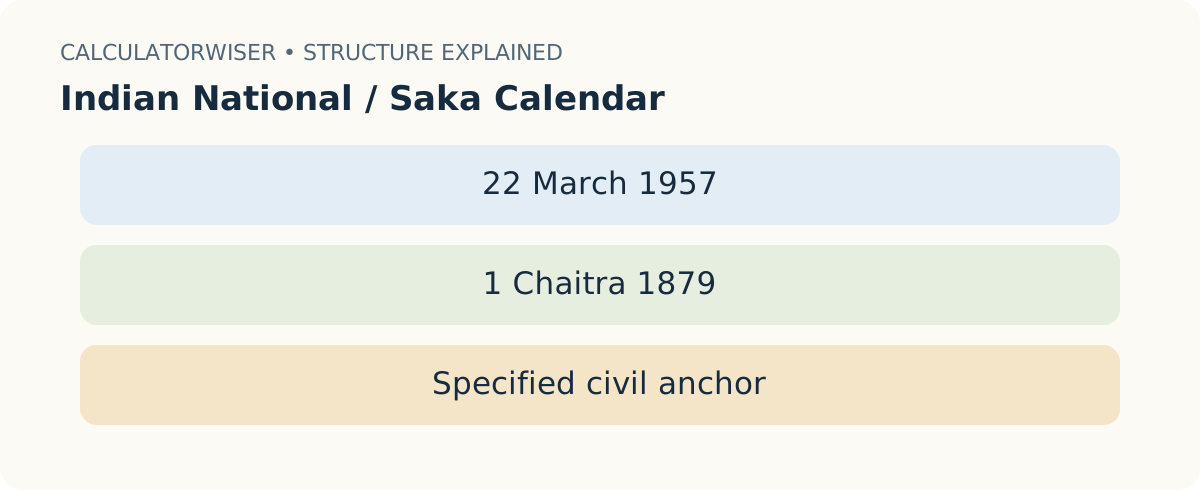
The national calendar took effect on 22 March 1957, corresponding to 1 Chaitra 1879 Saka. The Positional Astronomy Centre publishes the Rashtriya Panchang to provide astronomical and calendrical information on a scientific basis.
How the system works
The Panchang brings together national-calendar dates, regional astronomical conventions, Gregorian dates and other information. Its daily material includes lunar quantities and festival information, so a publication can describe several systems without those systems becoming identical.
Worked example
The adoption-date correspondence is a useful historical anchor: 22 March 1957 and 1 Chaitra 1879 identify the same stated day. It is not permission to subtract 78 from every Gregorian date without checking the year boundary.
What to watch for
“Indian calendar” is not one universal calendar. Specify Saka national, a regional solar calendar, or the relevant religious lunisolar tradition when making a comparison.
Modern Scientific · Continuous day count
Julian Day / Julian Date
Astronomers can compare events using a continuous numerical count instead of a calendar’s month names.
History and people
Julian Date counts days and fractions from a conventional epoch at noon Universal Time on 1 January 4713 BCE in the Julian calendar. The noon boundary helps distinguish it from ordinary civil dates.
How the system works
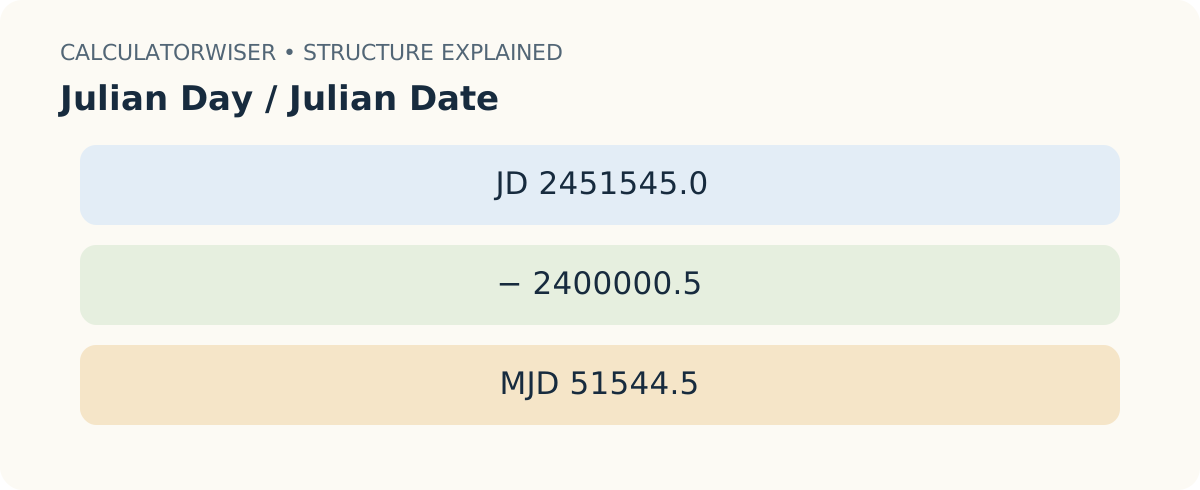
Whole units represent days; fractions represent parts of a day. Modified Julian Date subtracts 2,400,000.5, giving smaller values and a midnight rather than noon boundary.
Worked example
At 12:00 UT on 1 January 2000, JD is 2,451,545.0. Subtracting 2,400,000.5 gives MJD 51,544.5. At midnight at the beginning of that day, the values are JD 2,451,544.5 and MJD 51,544.0.
What to watch for
The Julian calendar and Julian Date are different concepts. Include the time and time scale when precision matters: a date-only input cannot identify a unique fractional day.
Modern Computing · Computer timestamp
Unix Time
A computer timestamp expresses a time relative to an epoch; it is not another cultural month-and-year calendar.
History and people
POSIX defines time relative to the epoch at the beginning of 1 January 1970. This representation enables software to order and exchange timestamps numerically.
How the system works
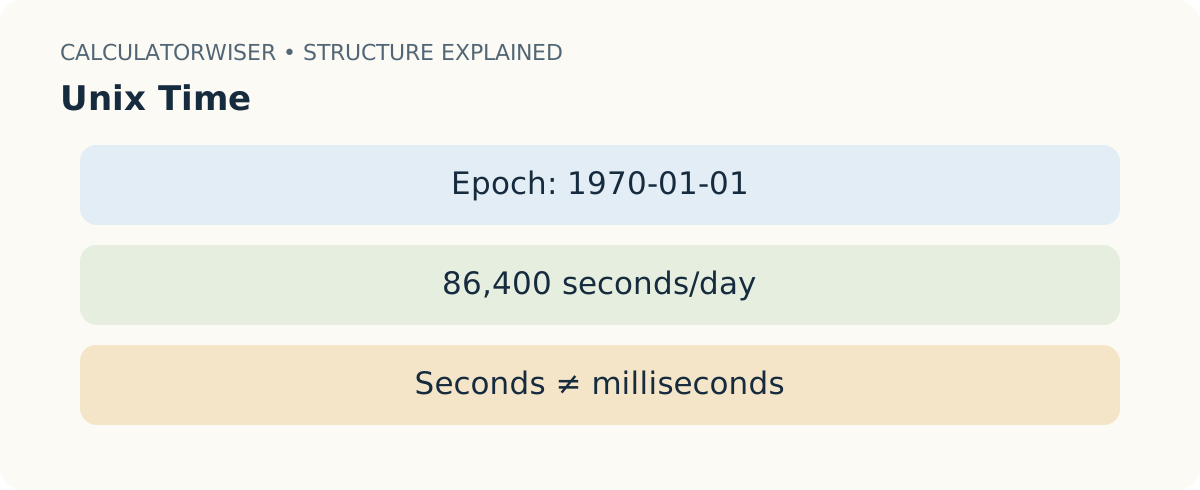
The usual seconds-since-epoch model treats each day as 86,400 seconds and does not count inserted leap seconds in the way an uninterrupted atomic-time count would. A displayed local date also depends on the chosen time zone.
Worked example
Epoch zero corresponds to 1970-01-01 00:00:00 UTC. The value 86,400 corresponds to the next day at 00:00:00 UTC in this model. Seconds and milliseconds differ by a factor of one thousand.
What to watch for
Never silently read a seconds value as milliseconds. A timestamp alone also does not encode the user’s preferred local time zone or calendar; those are display choices.
About this object
Historical context: an Egyptian inscribed stela from the reign of Senwosret I; not a printed calendar.The Metropolitan Museum of Art · Gift of Edward S. Harkness, 1912 · Public domain / Open Access · Object recordAbout this object
Cultural context: a Maya ceramic vessel. This photograph is not a diagram of the Tzolkʼin.The Metropolitan Museum of Art · The Michael C. Rockefeller Memorial Collection, Gift of Nelson A. Rockefeller, 1963 · Public domain / Open Access · Object recordAbout this object
The Met identifies the day sign 1 House on the sculpture’s head. The front photograph does not make that inscription legible.The Metropolitan Museum of Art · Museum Purchase, 1900 · Public domain / Open Access · Object recordAbout this object
A gilt-bronze and mother-of-pearl calendar object. This is not a French Republican calendar artifact.The Metropolitan Museum of Art · Gift of Edward A. Penniman, 1909 · Public domain / Open Access · Object record17 histories
Ancient · SolarAncient Egyptian Civil CalendarTwelve regular months and five additional days gave Egyptian administrators a predictable 365-day framework.
Ancient · Solar
Ancient Egyptian Civil Calendar
Twelve regular months and five additional days gave Egyptian administrators a predictable 365-day framework.
History and people
By at least about 2450 BCE, Egypt had a civil calendar divided into Akhet, Peret and Shemu: inundation, emergence and harvest. Dates identified a day, month and season, usually alongside a ruler’s regnal year. The Nile and the reappearance of Sirius supplied important seasonal context, but the civil calendar was a separate counting system.
How the system works
Each season contained four 30-day months. Five epagomenal days stood outside those months. Without a regular leap day, the civil year gradually moved relative to the seasonal year.
Worked example
Twelve times 30 equals 360; adding five gives 365. Relative to a simplified 365.25-day year, the shortfall accumulates to about one day in four years. This arithmetic explains drift; it does not establish an exact ancient founding date.
What to watch for
The three season names do not prove that every civil date matched the Nile’s actual seasonal conditions. Reconstructing a date also requires the reign and the chronology being used.
About this object
Historical context: an Egyptian inscribed stela from the reign of Senwosret I; not a printed calendar.The Metropolitan Museum of Art · Gift of Edward S. Harkness, 1912 · Public domain / Open Access · Object recordAncient · LunisolarBabylonian CalendarMesopotamian timekeeping brought lunar months, seasonal needs and detailed astronomical records together.
Ancient · Lunisolar
Babylonian Calendar
Mesopotamian timekeeping brought lunar months, seasonal needs and detailed astronomical records together.
History and people
Astronomical tablets show the sophistication of Babylonian lunar calculations. British Museum tablet 55555 preserves numerical values for the mean synodic month and a year, illustrating the mathematical study behind ancient time reckoning.
How the system works
Lunar months alone do not fill a seasonal year. Intercalation—adding a month—can keep a lunar sequence near the seasonal cycle. This is the central problem faced by lunisolar calendar makers.
Worked example
Using the tablet’s mean month of 29.530594 days, twelve months total approximately 354.367 days. Compared with a 365.24-day seasonal year, that leaves roughly 10.87 days. An extra month addresses accumulated difference, rather than changing every month into a solar month.
What to watch for
A surviving procedure tablet is evidence of astronomical mathematics, not a universal rulebook for every Mesopotamian place and century. Historical reconstruction must identify the period and surviving records.
Classical · SolarJulian CalendarA straightforward leap-day rule improved Roman civil timekeeping, but accumulated seasonal drift over centuries.
Classical · Solar
Julian Calendar
A straightforward leap-day rule improved Roman civil timekeeping, but accumulated seasonal drift over centuries.
History and people
Julius Caesar introduced the Julian reform in 45 BCE. Its familiar rule adds a leap day every fourth year. A solar calendar can make administration easier because its year aims to follow the seasons instead of the changing Moon.
How the system works
Three 365-day years and one 366-day year average 365.25 days. That is slightly longer than the tropical year, so a small annual mismatch eventually becomes a visible calendar shift.
Worked example
Across four years: 365 + 365 + 365 + 366 = 1,461 days. Dividing by four gives 365.25. Gregorian century exceptions later reduced the average to 365.2425 days.
What to watch for
Do not confuse the Julian calendar with Julian Date, an astronomical day count. Nor should one fixed day offset be applied across all centuries: the two calendars’ leap rules differ.
Ancient to Modern · Ritual cycleMaya TzolkʼinA 260-day count pairs a repeating number with a repeating day name; it is a living tradition, not simply an ancient curiosity.
Ancient to Modern · Ritual cycle
Maya Tzolkʼin
A 260-day count pairs a repeating number with a repeating day name; it is a living tradition, not simply an ancient curiosity.
History and people
Maya daykeeping connects time to community, ceremony and the natural world. Smithsonian’s Living Maya Time presents contemporary Maya perspectives and the connections between the sacred count, agriculture and the Sun.
How the system works
Thirteen numbers progress together with twenty day names. Both advance daily. Since 13 and 20 have no common factor, an identical pair returns after 260 days.
Worked example
An abstract sequence begins 1/A, 2/B, and continues. After 13/M comes 1/N: the number wraps while the names continue. After twenty days the names wrap, but the numbers have moved on. The complete combination repeats after 13 × 20 days.
What to watch for
The 260-day count is not a twelve-month solar year. Interpretations and names vary among Maya languages and communities. Respect living daykeepers’ knowledge rather than treating all Maya practice as one extinct system.
About this object
Cultural context: a Maya ceramic vessel. This photograph is not a diagram of the Tzolkʼin.The Metropolitan Museum of Art · The Michael C. Rockefeller Memorial Collection, Gift of Nelson A. Rockefeller, 1963 · Public domain / Open Access · Object recordAncient to Modern · 365-day cycleMaya HaabʼEighteen twenty-day months followed by five Wayebʼ days form the Haabʼ annual cycle.
Ancient to Modern · 365-day cycle
Maya Haabʼ
Eighteen twenty-day months followed by five Wayebʼ days form the Haabʼ annual cycle.
History and people
The Haabʼ is one part of a broader Maya calendar tradition. Smithsonian describes its continuing role in offerings and ceremonies, including special observances during Wayebʼ in Guatemala’s highlands.
How the system works
The regular months supply 360 days; the five-day period completes 365. Used with the 260-day sacred count, it creates the repeating Calendar Round.
Worked example
The least common multiple of 260 and 365 is 18,980 days: 73 sacred cycles or 52 Haabʼ cycles. Thus an identical combination in these two counts returns after 52 Haabʼ years.
What to watch for
The 52-year Calendar Round is not the Long Count. A Haabʼ date alone repeats annually and does not uniquely identify an event across history. A complete record needs additional chronological context.
Ancient · Continuous countMaya Long CountThe Long Count distinguishes dates beyond recurring annual and ritual cycles through positional day counting.
Ancient · Continuous count
Maya Long Count
The Long Count distinguishes dates beyond recurring annual and ritual cycles through positional day counting.
History and people
The Long Count provides a larger chronological framework for Maya inscriptions. The celebrated date 13.0.0.0.0 in December 2012 marked a cycle boundary, not scientific evidence of a predicted global catastrophe.
How the system works
A kʼin is one day, a winal twenty days, a tun eighteen winals or 360 days, a kʼatun twenty tuns or 7,200 days, and a bʼakʼtun twenty kʼatuns or 144,000 days. The 18-winal step is an important exception to simple base-20 counting.
Worked example
1.0.0.0.0 represents 144,000 days from the chosen starting point. 0.0.1.0.0 represents 360 days. Adding one day to 0.0.0.17.19 carries into the next tun: 0.0.1.0.0.
What to watch for
A Gregorian correspondence requires a specified correlation between the two systems. This diagram explains the units; it is not a claim that every historical correlation is identical.
Ancient · Ritual cycleAztec TonalpohualliMexica ritual dates connected named days with numbers and with particular ceremonial meanings.
Ancient · Ritual cycle
Aztec Tonalpohualli
Mexica ritual dates connected named days with numbers and with particular ceremonial meanings.
History and people
The Met’s Cihuateotl sculpture offers a concrete example: a day sign on its head identifies “1 House.” The museum connects it with one of five calendrical days associated with these figures.
How the system works
The Tonalpohualli is a 260-day ritual sequence. A number from a thirteen-step cycle pairs with a name from a twenty-step cycle. This structural relationship resembles other Mesoamerican sacred counts, while cultural meanings remain specific.
Worked example
Thirteen times twenty gives 260 distinct number-name pairings before repetition. A label such as 1 House therefore identifies a position in a recurring count, not a unique Gregorian year.
What to watch for
The sculpture is a historical object bearing a day sign, not the Sun Stone and not a complete calendar chart. Maya and Mexica traditions should be identified separately.
About this object
The Met identifies the day sign 1 House on the sculpture’s head. The front photograph does not make that inscription legible.The Metropolitan Museum of Art · Museum Purchase, 1900 · Public domain / Open Access · Object recordAncient to Modern · LunisolarTraditional Chinese CalendarMoon-based months and Sun-based seasonal terms work together; “lunar calendar” alone misses half the system.
Ancient to Modern · Lunisolar
Traditional Chinese Calendar
Moon-based months and Sun-based seasonal terms work together; “lunar calendar” alone misses half the system.
History and people
The Hong Kong Observatory explains the calendar through lunar months and 24 solar terms. The seasonal vocabulary reflects historical agricultural conditions in central China. Its Gan-Zhi year practice uses Lunar New Year for the changeover, while some other traditions use Spring Commences.
How the system works
Ordinary years have twelve months; leap years have thirteen. Solar terms divide the apparent Sun’s ecliptic longitude into 24 sections of 15 degrees. Major terms help determine where an additional lunar month belongs.
Worked example
360 degrees divided by 24 gives 15 degrees per term. Twelve major and twelve minor terms alternate. A leap month repeats a month designation rather than adding a permanent thirteenth named month.
What to watch for
Calendar-year labels, zodiac folklore and astronomical solar terms are related traditions, but are not interchangeable definitions. Date conversion needs the calendar’s astronomical rules and relevant time convention.
Ancient to Modern · Naming cycleChinese Sexagenary CycleTen heavenly stems and twelve earthly branches combine into a recurring sixty-step sequence.
Ancient to Modern · Naming cycle
Chinese Sexagenary Cycle
Ten heavenly stems and twelve earthly branches combine into a recurring sixty-step sequence.
History and people
The Gan-Zhi cycle has named years for more than two thousand years. The Hong Kong Observatory discusses why an apparently simple question about the year can depend on which year-boundary convention is being used.
How the system works
The stem and branch both advance one step at a time. Because ten and twelve share a factor of two, the simultaneous sequence has sixty combinations, not all 120 mathematically possible pairings.
Worked example
The least common multiple of 10 and 12 is 60. After sixty steps, both counters return together to their starting points. This is a naming cycle rather than an extra sixty-year astronomical orbit.
What to watch for
Write down the boundary convention when interpreting an early-year birth date or historical year label. Lunar New Year and Spring Commences can fall on different dates.
Ancient to Modern · LunisolarHebrew / Jewish CalendarCalculated lunar months are kept near the seasons through a recurring pattern of additional months.
Ancient to Modern · Lunisolar
Hebrew / Jewish Calendar
Calculated lunar months are kept near the seasons through a recurring pattern of additional months.
History and people
Older practice relied on lunar observation. The later calculated calendar uses a nineteen-year framework alongside rules governing the beginning and length of the year.
How the system works
Twelve of the nineteen years have twelve months and seven have thirteen. Leap years occupy positions 3, 6, 8, 11, 14, 17 and 19. Postponement rules and variable month lengths mean ordinary years can have 353, 354 or 355 days; leap years 383, 384 or 385.
Worked example
Twelve common years contribute 144 months; seven leap years contribute 91. Together they give 235 months in nineteen years. The inserted month preserves the relationship between lunar dates and the seasonal year.
What to watch for
An extra Hebrew month is not the same mechanism as February 29. A simple Gregorian year offset does not fully convert the date; the month and year boundary matter.
Medieval to Modern · LunarIslamic / Hijri CalendarTwelve lunar months form a year that moves through the solar seasons instead of being held in one season.
Medieval to Modern · Lunar
Islamic / Hijri Calendar
Twelve lunar months form a year that moves through the solar seasons instead of being held in one season.
History and people
The Hijri era refers to the migration associated with the early Muslim community. Traditional month beginnings depend on crescent visibility, while tabular civil systems calculate a predictable sequence.
How the system works
Twelve lunar months are roughly eleven days shorter than a Gregorian year. In one tabular form, months alternate between thirty and twenty-nine days; eleven leap years in a thirty-year cycle add a day to the final month.
Worked example
A sequence of six 30-day and six 29-day months totals 354 days. Adding a leap day gives 355. The shorter year explains why a lunar observance occurs earlier in successive Gregorian years.
What to watch for
An astronomical new moon is not the same event as first crescent visibility. Weather, location and observing conditions affect visibility. A computed civil date should not be presented as every community’s final religious decision.
Early Modern to Modern · SolarGregorian CalendarThe internationally used civil calendar refines the Julian leap-day rule to follow the seasonal year more closely.
Early Modern to Modern · Solar
Gregorian Calendar
The internationally used civil calendar refines the Julian leap-day rule to follow the seasonal year more closely.
History and people
The Gregorian reform was introduced in 1582. The underlying problem was the gradual drift of the Julian calendar relative to the equinox; Easter calculations were an important motivation.
How the system works
Years divisible by four are leap years, except century years unless divisible by four hundred. Thus 1900 was common, 2000 was leap and 2100 will be common.
Worked example
In four hundred years there are 97 leap days: 400 × 365 + 97 = 146,097 days. Dividing by 400 gives an average of 365.2425 days.
What to watch for
Extending Gregorian rules into dates before their local adoption is called a proleptic calculation. That is useful mathematically, but it does not mean an original historical document used those rules.
About this object
A gilt-bronze and mother-of-pearl calendar object. This is not a French Republican calendar artifact.The Metropolitan Museum of Art · Gift of Edward A. Penniman, 1909 · Public domain / Open Access · Object recordEarly Modern / Revolutionary · Solar reformFrench Republican CalendarA revolutionary calendar attempted to reorganize everyday time around solar seasons and decimal divisions.
Early Modern / Revolutionary · Solar reform
French Republican Calendar
A revolutionary calendar attempted to reorganize everyday time around solar seasons and decimal divisions.
History and people
The revolutionary government began dating official acts from Year I after the monarchy’s abolition in September 1792. The new calendar structure was legislated in 1793 and applied retrospectively to the Republic’s starting date.
How the system works
The regular year had twelve thirty-day months, each divided into three ten-day décades. Five complementary days completed an ordinary year, with an additional day for a leap year. Month names evoked seasonal weather and agriculture.
Worked example
Twelve times thirty supplies 360 days. Adding five produces 365. A ten-day week reorganizes the rhythm of work and rest; it is not merely a translation of Monday through Sunday.
What to watch for
Do not confuse the later nineteenth-century French desk calendar pictured elsewhere in this gallery with a Republican-calendar artifact. Revolutionary dates also need careful treatment of the calendar’s historical year-start rule.
Modern civil use · Era numberingJapanese Era CalendarAn era name changes the year label without requiring a different modern month-and-day grid.
Modern civil use · Era numbering
Japanese Era Calendar
An era name changes the year label without requiring a different modern month-and-day grid.
History and people
The National Astronomical Observatory of Japan publishes calendars using both Gregorian years and era years. Its 2019 material identifies that year as Heisei 31 / Reiwa 1, showing an era change within a single Gregorian year.
How the system works
An era year begins with the first year of the named era, not with a universal numerical offset valid across all reigns. Historical Japanese lunisolar dates are a separate conversion problem from modern era labels.
Worked example
A document labeled only “year 1” is incomplete unless the era is known. Even the label “2019” is insufficient to choose between Heisei 31 and Reiwa 1 without the actual date.
What to watch for
Use a historical era table when converting archival material. NAOJ’s database flags uncertainties in some old era start dates, demonstrating why a modern label conversion should not be stretched into an exact ancient chronology.
Modern · SolarIndian National / Saka CalendarIndia’s national calendar is a standardized civil framework; the country’s regional and religious calendars remain diverse.
Modern · Solar
Indian National / Saka Calendar
India’s national calendar is a standardized civil framework; the country’s regional and religious calendars remain diverse.
History and people
The national calendar took effect on 22 March 1957, corresponding to 1 Chaitra 1879 Saka. The Positional Astronomy Centre publishes the Rashtriya Panchang to provide astronomical and calendrical information on a scientific basis.
How the system works
The Panchang brings together national-calendar dates, regional astronomical conventions, Gregorian dates and other information. Its daily material includes lunar quantities and festival information, so a publication can describe several systems without those systems becoming identical.
Worked example
The adoption-date correspondence is a useful historical anchor: 22 March 1957 and 1 Chaitra 1879 identify the same stated day. It is not permission to subtract 78 from every Gregorian date without checking the year boundary.
What to watch for
“Indian calendar” is not one universal calendar. Specify Saka national, a regional solar calendar, or the relevant religious lunisolar tradition when making a comparison.
Modern Scientific · Continuous day countJulian Day / Julian DateAstronomers can compare events using a continuous numerical count instead of a calendar’s month names.
Modern Scientific · Continuous day count
Julian Day / Julian Date
Astronomers can compare events using a continuous numerical count instead of a calendar’s month names.
History and people
Julian Date counts days and fractions from a conventional epoch at noon Universal Time on 1 January 4713 BCE in the Julian calendar. The noon boundary helps distinguish it from ordinary civil dates.
How the system works
Whole units represent days; fractions represent parts of a day. Modified Julian Date subtracts 2,400,000.5, giving smaller values and a midnight rather than noon boundary.
Worked example
At 12:00 UT on 1 January 2000, JD is 2,451,545.0. Subtracting 2,400,000.5 gives MJD 51,544.5. At midnight at the beginning of that day, the values are JD 2,451,544.5 and MJD 51,544.0.
What to watch for
The Julian calendar and Julian Date are different concepts. Include the time and time scale when precision matters: a date-only input cannot identify a unique fractional day.
Modern Computing · Computer timestampUnix TimeA computer timestamp expresses a time relative to an epoch; it is not another cultural month-and-year calendar.
Modern Computing · Computer timestamp
Unix Time
A computer timestamp expresses a time relative to an epoch; it is not another cultural month-and-year calendar.
History and people
POSIX defines time relative to the epoch at the beginning of 1 January 1970. This representation enables software to order and exchange timestamps numerically.
How the system works
The usual seconds-since-epoch model treats each day as 86,400 seconds and does not count inserted leap seconds in the way an uninterrupted atomic-time count would. A displayed local date also depends on the chosen time zone.
Worked example
Epoch zero corresponds to 1970-01-01 00:00:00 UTC. The value 86,400 corresponds to the next day at 00:00:00 UTC in this model. Seconds and milliseconds differ by a factor of one thousand.
What to watch for
Never silently read a seconds value as milliseconds. A timestamp alone also does not encode the user’s preferred local time zone or calendar; those are display choices.
No histories match. Try another word or choose All periods.
Ancient → Classical → Medieval → Modern → Computing
World Calendar Archive
A visual encyclopedia of 57 calendar and time-reckoning systems—from ancient Egyptian and Babylonian traditions to Gregorian, Hijri, Chinese, Hebrew, Persian, Hindu, Maya, Japanese eras, ISO week dates, Julian Date, Unix time and modern calendar reform proposals.

Astronomical & zodiac style

Historic perpetual calendar plates

Modern year-grid style

Ornate manuscript-style tables
Moon phase & seasonal style

Ancient cycle diagrams
Ancient Egyptian Civil Calendar
One of the earliest well-documented civil calendars. The civil year was divided into three seasons—Akhet, Peret, and Shemu—with four months in each season. Because the classic civil form had no leap day, it drifted through the seasons over long periods.
Ancient Egypt · Solar
Babylonian Calendar
Babylonian timekeeping helped shape later Near Eastern calendrical practice. Month starts were tied to the Moon, while intercalation kept the calendar from drifting too far from the agricultural seasons.
Mesopotamia · LunisolarAssyrian Calendar Traditions
Assyrian calendrical traditions formed part of the wider Mesopotamian world of lunar months, seasonal festivals, and state chronology.
Ancient Assyria / Mesopotamia · LunisolarAttic Calendar
The Attic calendar was deeply connected to civic and religious life in Athens. Its practical use was local and could involve decisions that make exact modern conversion difficult.
Ancient Athens · Lunisolar
Ancient Hebrew Observational Calendar
Earlier Hebrew calendar practice used observation more directly than the later fixed calculated calendar. Historical month starts and intercalation cannot always be reconstructed with perfect certainty.
Ancient Israel · LunisolarRoman Republican Calendar
Before Julius Caesar's reform, Roman calendrical administration could become misaligned with the seasons. Intercalation was not consistently applied, which complicates exact conversion of some historical dates.
Roman Republic · Lunisolar / CivicJulian Calendar
The Julian reform regularized the Roman year. Its simple four-year leap cycle is slightly too long relative to the tropical year, which eventually motivated Gregorian reform.
Roman world; later Europe and Christian traditions · SolarMaya Tzolkʼin
The Tzolkʼin is a 260-day cycle rather than a solar year. It interlocks with other Maya cycles and remains culturally important in some Maya communities.
Mesoamerica · Cycle-basedMaya Haabʼ
The 365-day Haabʼ worked together with the Tzolkʼin to form the larger Calendar Round.
Mesoamerica · Solar-like cycleMaya Long Count
Unlike the repeating ritual and solar cycles, the Long Count identifies dates within an extended chronological framework.
Mesoamerica · Continuous countAztec Tonalpohualli
The tonalpohualli combined number and day-sign cycles and operated alongside a 365-day year cycle.
Central Mexico · Cycle-basedAztec Xiuhpohualli
The xiuhpohualli structured the annual ceremonial cycle and interlocked with the ritual 260-day count.
Central Mexico · Solar-like cycleTraditional Chinese Calendar
The Chinese calendar uses astronomical relationships involving lunar phases and solar terms. It remains important for Lunar New Year and other traditional festivals even though the Gregorian calendar is used for civil purposes.
China and Chinese communities worldwide · LunisolarChinese Sexagenary Cycle
The sexagenary system names years and other time units through repeating stem-branch combinations. It is related to, but distinct from, the 12-animal zodiac cycle.
East Asia · Cycle-basedHebrew / Jewish Calendar
The fixed Hebrew calendar coordinates lunar months with the solar year. Rules for postponements and variable month lengths make it more sophisticated than a simple 19-year leap-month table.
Jewish communities worldwide · LunisolarCoptic Calendar
The Coptic calendar preserves a 13-month structure derived from Egyptian/Alexandrian traditions and is closely related in structure to the Ethiopian calendar.
Coptic Christian communities · SolarEthiopian Calendar
The Ethiopian calendar is a living civil calendar with its own era numbering and 13-month structure. Its year numbering differs from the Gregorian year.
Ethiopia · SolarArmenian Calendar
The traditional Armenian calendar belongs to the family of fixed 365-day systems used in the region and is important in medieval Armenian chronology.
Historic Armenia · SolarByzantine Calendar
The Byzantine system is best understood as an era and year-numbering framework layered onto the Julian calendar rather than a wholly different month structure.
Byzantine Empire and Orthodox world · Solar / EraIslamic / Hijri Calendar
Because it is purely lunar, the Hijri year moves through the seasons. Observational practice and calculated systems can produce differences of a day in month starts.
Muslim communities worldwide · LunarTabular Islamic / Civil Calendar
The tabular form provides deterministic dates without requiring local crescent observation, so it can differ from observed religious calendars.
Computational use · Lunar arithmeticUmm al-Qura Calendar
Umm al-Qura is distinct from a generic tabular Islamic calendar and from local observational determinations used elsewhere.
Saudi Arabia · Lunar
Persian / Solar Hijri Calendar
The Solar Hijri year is anchored to the spring equinox and shares its era origin with the Hijri tradition while using a solar, not lunar, year.
Iran and Afghanistan · SolarJalali Calendar
The Jalali reform is famously associated with a group of astronomers including Omar Khayyam and is an important milestone in Persian solar calendrical history.
Persian world · SolarZoroastrian Calendars
There is no single universal modern Zoroastrian calendar practice; communities may use different calendrical reckonings, which should be identified explicitly when converting dates.
Iranian and Parsi communities · Solar / ReligiousHindu Panchanga Calendars
There is no single Hindu calendar. Regional variants can differ in month boundaries, year numbering, whether months begin near new or full moon, and other rules.
India, Nepal, Bali and Hindu communities worldwide · LunisolarVikram Samvat
Vikram Samvat is an era with multiple calendrical implementations rather than one uniform rule set across South Asia.
India and Nepal · Lunisolar / Solar regional variants
Nepal Bikram Sambat
Government calendars in Nepal commonly display Bikram Sambat and Gregorian dates together, including public holidays and festivals.
Nepal · SolarIndian National / Saka Calendar
The Indian National Calendar is a standardized modern civil calendar using the Saka era; it should not be confused with the many regional Hindu calendars.
India · SolarBengali Calendar
The Bengali calendar has undergone reforms, so Bangladesh and West Bengal contexts should not be treated as interchangeable for all historical dates.
Bangladesh and eastern South Asia · SolarTamil Calendar
The Tamil calendar is one of several regional Indian calendar traditions and should be presented with its own month names and festival context.
Tamil communities · SolarMalayalam / Kollam Era Calendar
The Malayalam calendar combines a regional solar calendar with Kollam Era year numbering.
Kerala · SolarTibetan Calendar
The Tibetan calendar is calculation-intensive; local traditions and schools may matter for precise festival dating.
Tibetan cultural regions · LunisolarThai Lunar Calendar
Thailand uses the Gregorian calendar for modern civil structure while lunar dates remain important for Buddhist observance and traditional festivals.
Thailand · LunisolarThai Solar / Buddhist Era Calendar
Modern Thai dates often use Gregorian month structure with Buddhist Era year numbering, which is typically 543 years ahead of Common Era numbering for contemporary dates.
Thailand · Solar / EraBuddhist Era Calendars
“Buddhist calendar” is a family label. Thai, Burmese, Sri Lankan and other traditions should be distinguished when precise rules matter.
South and Southeast Asia · Era familyBalinese Pawukon Calendar
Pawukon is fundamentally different from a normal month-based solar calendar. Multiple week cycles overlap within a repeating 210-day framework.
Bali, Indonesia · Cycle-basedBalinese Saka Calendar
Bali uses more than one traditional time system; the Saka calendar and Pawukon serve different calendrical functions.
Bali, Indonesia · LunisolarJavanese Calendar
The Javanese calendar is a hybrid tradition and is especially notable for combining lunar dating with indigenous cyclic week systems.
Java, Indonesia · Lunar / Cycle hybridKorean Dangi / Traditional Calendar
Modern Korea uses Gregorian civil dating, while traditional lunisolar dates continue to matter for holidays and cultural observance.
Korea · Lunisolar / EraJapanese Era Calendar
Japan uses the Gregorian calendar alongside era names. The current Reiwa era began in 2019, making 2026 Reiwa 8.
Japan · Solar / EraMinguo / Republic of China Calendar
Minguo year 1 corresponds to 1912 CE. It is an era-numbering system over the Gregorian calendar structure.
Taiwan · Solar / Era
Baháʼí / Badíʿ Calendar
The Badíʿ calendar uses a distinctive 19×19 structure and intercalary days called Ayyám-i-Há. Baháʼí New Year, Naw-Rúz, is tied to the vernal equinox.
Baháʼí communities worldwide · SolarNanakshahi Calendar
Nanakshahi calendars are published by Sikh institutions. Because community practice has evolved, specific edition/rules should be stated when precise observance dates are presented.
Sikh communities · SolarGregorian Calendar
The Gregorian reform reduced the long-term drift of the Julian calendar and is now the primary civil calendar used internationally, though many communities retain parallel religious or traditional calendars.
Worldwide · SolarRevised Julian Calendar
The Revised Julian calendar should not be confused with the older Julian calendar; its leap rule differs even though many current dates align with Gregorian dates.
Some Eastern Orthodox churches · SolarFrench Republican Calendar
The Republican calendar was created to break with ancien-régime conventions and used nature-themed month names. It was used officially for roughly a decade before being abandoned.
Revolutionary France · Solar / Decimalized civicRumi / Ottoman Fiscal Calendar
The Rumi calendar arose from the need to align taxation and administration more closely with the solar year than the lunar Hijri calendar allowed.
Ottoman Empire · Solar / FiscalSoviet Revolutionary Work Calendars
These were work-schedule reforms rather than a complete replacement of the Gregorian date system. They are important examples of modern attempts to redesign the social week.
Soviet Union · Reform / Work-cycle
International Fixed Calendar
The International Fixed Calendar sought regularity and month-to-month symmetry but was never adopted as the global civil standard.
International proposal · Proposed SolarWorld Calendar
The World Calendar proposal aimed to make quarters structurally identical. Objections included the treatment of extra days outside the seven-day week cycle.
International proposal · Proposed SolarPositivist Calendar
The Positivist calendar tied timekeeping to a commemorative program of historical figures and illustrates how calendar design can encode ideology.
19th-century intellectual history · Proposed Solar
ISO 8601 Week-Date
ISO 8601 provides unambiguous numeric date/time representations and includes week dates, ordinal dates, time intervals and UTC-related formats.
Worldwide · Week-based
Julian Day / Julian Date
Julian Date is not the same thing as the Julian calendar. Astronomers use it as a continuous numerical time variable; at 0h UT1, the Julian Date ends in .5.
Astronomy worldwide · Continuous day countModified Julian Date
Modified Julian Date shortens the Julian Date number and shifts the day boundary to midnight for convenient technical use.
Astronomy / geodesy / technical systems · Continuous day countUnix Time
Unix time is a machine-oriented timestamp rather than a cultural calendar, but it is central to modern digital chronology.
Computing worldwide · Continuous second countGPS Time
GPS Time is a technical timescale used by the Global Positioning System and differs from UTC because of leap-second treatment.
Global navigation systems · Continuous week/second countGuardar en Pinterest