CalculatorWiser / Forgotten technology
Legacy Repair Workshop
Understand the fault. Preserve the evidence. Restore with a plan.
Progress can be saved in this browser when JavaScript and local storage are available.
Legacy CRT Television & Monitor Diagnosis / Lesson 2 of 6
Raster collapse, size and scan-direction reasoning
Understand the system
A raster is formed by horizontal and vertical deflection working together. Loss of one scan direction can compress the image into a narrow line; the direction of that line helps identify which scan dimension is missing. It is still only a functional clue. A collapse can concentrate beam energy and damage phosphor, so this is a stop condition rather than a convenient pattern to study repeatedly.
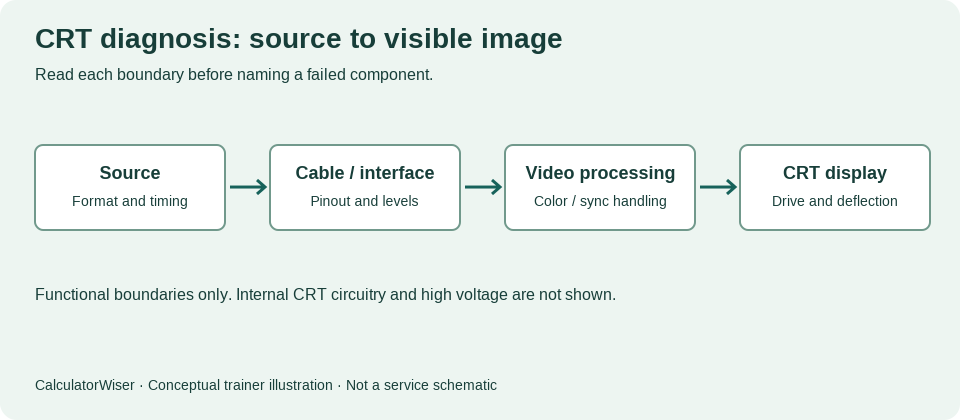
Diagnostic method
Analyze drawings and photographs rather than reproducing faults on equipment. Label screen horizontal and vertical axes. Compare a full rectangle, a horizontal line and a vertical line. Document whether a symptom is continuous or intermittent and which chassis is installed. Do not confuse deflection geometry with source aspect ratio or an overscan setting. Do not instruct a learner to adjust internal size controls or continue operation on a collapsed raster.
Case study: read the evidence
A supplied photograph shows a bright horizontal line across a screen. The learner writes 'horizontal scan failed because the line is horizontal.'
Reveal the diagnostic reasoning
The line shows horizontal spread still exists while vertical spread is absent or greatly reduced. It suggests a vertical-deflection fault area, not proof of a particular IC or capacitor. The correct response includes stopping operation and referring for qualified chassis-specific service.
Your practical or paper exercise
Sketch the three raster shapes and annotate the missing dimension. Explain why line direction and failed scan direction are easy to confuse.
Notes stay in this browser. They are not submitted to CalculatorWiser.
Compare with the worked answer
A horizontal line lacks vertical height; a vertical line lacks horizontal width. Real symptoms can have more complex causes, so these are diagnostic clues rather than universal component rules.
Repair evidence worksheet
For this case, record: equipment identity; exact symptom; expected behavior and source of that expectation; competing causes; evidence for and against each; next safe step; qualified-service needs; parts justification; acceptance criteria and remaining unknowns.
References and original manuals
Lessons and fictional cases are original. These links provide further reading, not permission to copy or resell manuals. A manual for another chassis or controller is not a substitute for the installed model’s service documents. Historic procedures may not meet present safety practice. No external document loads automatically.
Guardar en Pinterest