TV Repair Masterclass
Antique tube receivers, solid-state CRT televisions and modern flat panels—three focused tracks with smaller courses and free sample lessons.
Antique Tube Television Restoration
32 illustrated and focused lessons in antique tube-TV theory, symptom diagnosis, restoration planning and service records, with searchable learner Q&A, original exercises and documented historical case references.
Explore antique TV in greater depth
The 16 illustrated foundation lessons are joined by 16 focused diagnosis and service-planning lessons. Search the full 32-lesson track below. Study tube anatomy, CRT image formation, signal paths, bias, filtering, coupling, scan patterns, sound recovery and color theory, then apply them to restoration cases.
Start with the two free previews. The remaining illustrated lessons are included with your mini-course, full-track or complete-program access.
Preview the illustrated receiver guideAntique TV Identification & Restoration Planning
Identify the chassis, obtain the right documentation and plan restoration before power is applied.
8 lessons • included in this full track and the complete program
Open mini course →Paid enrollment is not open yet. Try the free samples.Tube Circuits, Power & Signal Theory
Understand stage functions and component behavior using schematics and low-voltage models.
8 lessons • included in this full track and the complete program
Open mini course →Paid enrollment is not open yet. Try the free samples.Scanning, Picture & Sound Diagnosis
Connect timing, deflection, beam control and audio behavior to defensible diagnoses.
8 lessons • included in this full track and the complete program
Open mini course →Paid enrollment is not open yet. Try the free samples.Restoration Cases & Professional Handover
Use evidence-led case work, written acceptance criteria and restoration records.
8 lessons • included in this full track and the complete program
Open mini course →Paid enrollment is not open yet. Try the free samples.Find a tube-TV lesson, symptom or question
Search titles and learner questions. Lesson access follows your existing mini-course, full-track or complete-program purchase.
- Free sample: identify an antique tube televisionAntique TV Identification & Restoration Planning • Free sample
- Free sample: trace the receiver’s functional blocksAntique TV Identification & Restoration Planning • Free sample
- Service literature and chassis revisionsAntique TV Identification & Restoration Planning • Included lesson
- Preservation priorities and repair economicsAntique TV Identification & Restoration Planning • Included lesson
- Turn a vague complaint into useful evidenceAntique TV Identification & Restoration Planning • Included lesson
- Read service charts without inventing universal voltagesAntique TV Identification & Restoration Planning • Included lesson
- Repair, restoration and previous modificationsAntique TV Identification & Restoration Planning • Included lesson
- Isolation, stored charge and the limits of test equipmentAntique TV Identification & Restoration Planning • Included lesson
- Vacuum-tube stages and biasTube Circuits, Power & Signal Theory • Included lesson
- Rectification, filtering and rippleTube Circuits, Power & Signal Theory • Included lesson
- Coupling, leakage and component specificationsTube Circuits, Power & Signal Theory • Included lesson
- Signal tracing as a reasoning methodTube Circuits, Power & Signal Theory • Included lesson
- No-start complaints and heater-system reasoningTube Circuits, Power & Signal Theory • Included lesson
- Capacitors, resistors and replacement-induced faultsTube Circuits, Power & Signal Theory • Included lesson
- Hum bars: electrical ripple versus magnetic interferenceTube Circuits, Power & Signal Theory • Included lesson
- Tube testers, bias and circuit-level evidenceTube Circuits, Power & Signal Theory • Included lesson
- Raster, synchronization and deflectionScanning, Picture & Sound Diagnosis • Included lesson
- Monochrome picture quality and gainScanning, Picture & Sound Diagnosis • Included lesson
- Audio path and intercarrier conceptsScanning, Picture & Sound Diagnosis • Included lesson
- Color tube-era systems and preservationScanning, Picture & Sound Diagnosis • Included lesson
- Raster present, sound present, picture missingScanning, Picture & Sound Diagnosis • Included lesson
- Rolling, tearing, foldover and collapse: distinguish the complaintScanning, Picture & Sound Diagnosis • Included lesson
- Color purity, convergence, grayscale and decoder faultsScanning, Picture & Sound Diagnosis • Included lesson
- Sound buzz, weak reception and source compatibilityScanning, Picture & Sound Diagnosis • Included lesson
- Case: weak picture with acceptable soundRestoration Cases & Professional Handover • Included lesson
- Case: hum, heating and a restricted restoration scopeRestoration Cases & Professional Handover • Included lesson
- Parts provenance and verification recordsRestoration Cases & Professional Handover • Included lesson
- Antique-track capstoneRestoration Cases & Professional Handover • Included lesson
- Warmup and intermittent faults: build a repeatability logRestoration Cases & Professional Handover • Included lesson
- Documented case: CT-100 convergence failure affects focusRestoration Cases & Professional Handover • Included lesson
- Service records, repair estimates and return complaintsRestoration Cases & Professional Handover • Included lesson
- Advanced capstone: three faults, three evidence-led reportsRestoration Cases & Professional Handover • Included lesson
No matching lessons. Try a shorter symptom or circuit name.
Free sample: identify an antique tube television
Learning goal: Build a reliable identity and condition record without energizing an unknown receiver.
An antique tube television usually has a CRT picture tube plus multiple vacuum tubes performing functions such as amplification, oscillation and rectification. The cabinet model and chassis identification can be different, and a cabinet may contain a replacement chassis. A photograph of the front is not sufficient to select parts or a service procedure.
Begin with external labels, provenance and the owner’s description. Record the cabinet model, chassis number if visible without opening the set, mains rating, missing controls, visible damage and modifications mentioned by the owner. Do not apply power to an unknown old receiver merely to obtain a symptom. A qualified restorer must first assess deterioration and the circuit’s hazards.
Choose a restoration objective: historical display, externally preserved exhibit, or professionally assessed operation. These objectives demand different evidence and budgets. Treat a brightly polished cabinet as an appearance observation, not proof of electrical condition. Request the exact service documentation before discussing internal work.
Illustrated lesson guide
Select any illustration to open a larger view. Original conceptual graphics; not model-specific wiring or service instructions.
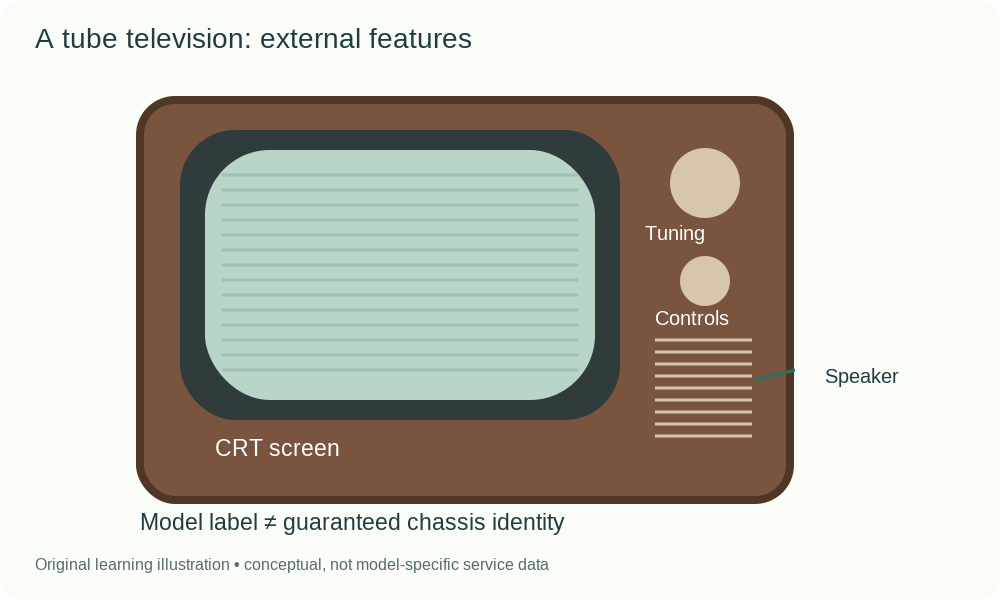
An original representative receiver illustration. Cabinet appearance cannot identify the chassis or establish electrical condition.
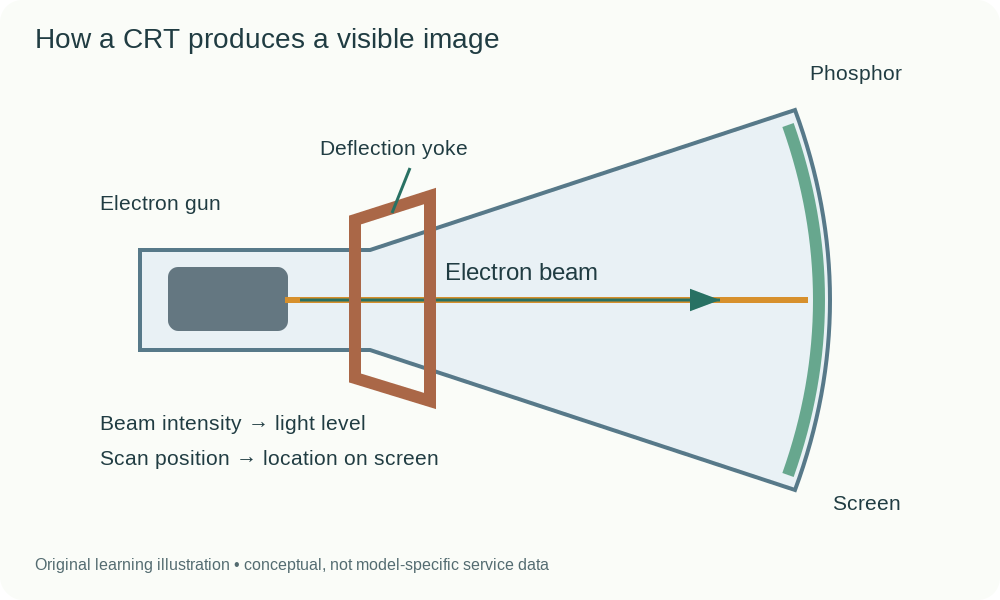
Conceptual CRT cutaway showing beam formation and the phosphor screen. The illustrated yoke represents magnetic deflection; other historical designs use electrostatic deflection.
Two kinds of tube, two different jobs
The large picture tube is a cathode-ray tube (CRT). Smaller receiving tubes form the receiver electronics. A set can contain a CRT yet use transistors for its other circuits; that is why this course keeps antique tube receivers separate from later solid-state CRT televisions. A hybrid chassis may contain both tubes and transistors. Classify the electronics from matching documentation, not from the screen shape or cabinet age.
A diode has two principal active electrodes and can rectify a signal or supply. A triode adds a control grid and can amplify or oscillate. A pentode adds screen and suppressor structures to reduce unwanted interactions. Some envelopes contain multiple sections, so counting glass bulbs does not tell you the number of circuit stages.
Build an illustrated identity record
Use a front photograph, external label photograph, control map and a document register. Include an empty field for the chassis number when it is not externally visible; do not remove covers merely to fill it in. Separate markings you actually read from seller claims. Record whether the display is direct-view, mirror-view or projection, and whether the literature describes monochrome, color or a hybrid design.
A useful catalog entry has: manufacturer; cabinet model; chassis/revision; country and television standard; documented date range; screen type; dimensions; included accessories; provenance; and restoration goal. An uncertain year should remain a range rather than become an invented exact date.
How the technology developed
Mechanical television used moving scanning mechanisms. Early electronic receivers moved scanning into the CRT system; postwar tube receivers brought larger direct-view screens into homes. Tube-era color receivers added color decoding and more demanding beam alignment. Hybrids gradually mixed semiconductor and tube functions before solid-state designs became common. These are overlapping design families, not universal date boundaries.
| Record | Illustration to collect | Why it matters |
|---|---|---|
| Identity | External label and front view | Avoids a cabinet/chassis mismatch |
| Controls | Labeled control sketch | Distinguishes missing controls from faults |
| Condition | Visible damage and completeness | Supports a preservation plan |
| Documentation | Cover and chassis coverage | Confirms the correct service revision |
Questions learners ask
Are all round-screen sets the same?
No. Screen shape is only one identification clue. Chassis, tube complement, scan system and receiver standard still matter.
Does a glowing tube prove that it is good?
No. Heater operation does not establish emission, leakage, gain, bias or correct circuit operation.
Tube-TV glossary — 28 terms
- AGC
- Automatic gain control: regulates amplification as received signal level changes.
- Anode / plate
- An electrode that collects electrons in a receiving tube.
- Bias
- The resting electrical operating condition around which a signal varies.
- Blanking
- Suppression of visible beam output during scanning return intervals.
- Cathode
- The electron-emitting electrode in a thermionic tube.
- Chassis
- The receiver assembly or its model identity; it may differ from the cabinet model.
- Chrominance
- The color-information component of a compatible color television signal.
- Convergence
- Alignment of component color images on the screen.
- Coupling
- Transfer of signal information between circuit stages.
- CRT
- Cathode-ray tube: an electron-beam display using a phosphor screen.
- Deflection
- Control of the electron beam’s position.
- Detection / demodulation
- Recovery of information carried by a modulated signal.
- Field
- One scan sequence; interlaced systems use complementary fields to form a frame.
- Flyback / retrace
- The return portion of a scanning cycle; associated circuit details vary.
- Focus
- Concentration of the beam into a suitably small spot on the screen.
- Frame
- A complete image sequence; distinguish it from a field in interlaced systems.
- Getter
- Material used to help maintain a tube’s vacuum after manufacture.
- Heater
- The element warming a cathode in an indirectly heated tube.
- IF
- Intermediate frequency: a converted-frequency region used in receiver processing.
- Intercarrier sound
- A sound-recovery arrangement using a difference-frequency relationship.
- Luminance
- The brightness-information component of a television signal.
- Pentode
- A receiving-tube category with cathode, plate and three grid functions.
- Phosphor
- Screen material that emits visible light when excited by the beam.
- Purity
- The intended beam-to-color-phosphor relationship in a color CRT.
- Raster
- The scanned illuminated area, whether or not it contains a useful image.
- Ripple
- Periodic variation remaining on an otherwise DC-like supply.
- Synchronization
- Coordination of receiver scanning with transmitted timing information.
- Transconductance
- Small-signal change in plate current per grid-voltage change at stated conditions.
Diagnostic case
A collector offers a wooden television marked Model A, but its paperwork refers to Chassis B. The intake should preserve both identifiers and flag the mismatch. The correct next step is documentation and expert identity assessment, not ordering a tube set for Model A.
Fictional training case; the observations are not measurements from your television.
Practice task / worksheet
Create an intake sheet for a fictional receiver: identifiers, visible condition, accessories, provenance, restoration goal, and five unanswered questions. Do not open or power equipment to complete this exercise.
Printable diagnostic worksheet
- Model, chassis and revision
- _______________________________
- Symptom and when it occurs
- _______________________________
- Evidence versus assumptions
- _______________________________
- Three competing hypotheses
- _______________________________
- Documentation and qualified assessment required
- _______________________________
- Approved scope and verification criteria
- _______________________________
Check your reasoning
What should happen before an unknown antique set is energized?
Unknown deterioration and design hazards make an informal power test inappropriate.
References and further reading
Original written lessons and fictional diagnostic cases. Manufacturer service procedures must be obtained for the exact equipment; linked manuals are not resold as course downloads.
- iFixit: display safety
- Early Television Museum: RCA manufacturer service literature
- RCA CRT training manual archive
- RCA 621TS manufacturer service manual (historical reference)
- RCA CRT manufacturing training: Chapters 1–4
- RCA CRT training glossary
- Early Television Museum — restoration advice
- RCA Television Service Clinic — CT-100 (historical manufacturer reference)
- Early Television Museum — firsthand RCA TT-5 restoration record
- Pete Deksnis — CT-100 restoration and reliability observations
- Samuel M. Goldwasser — TV repair FAQ (mixed CRT generations; interpret by design)
Save to Pinterest