CalculatorWiser / Forgotten technology
Legacy Repair Workshop
Understand the fault. Preserve the evidence. Restore with a plan.
Progress can be saved in this browser when JavaScript and local storage are available.
Classic Arcade Cabinet & Logic Repair / Lesson 6 of 6
Classic restoration capstone and acceptance matrix
Understand the system
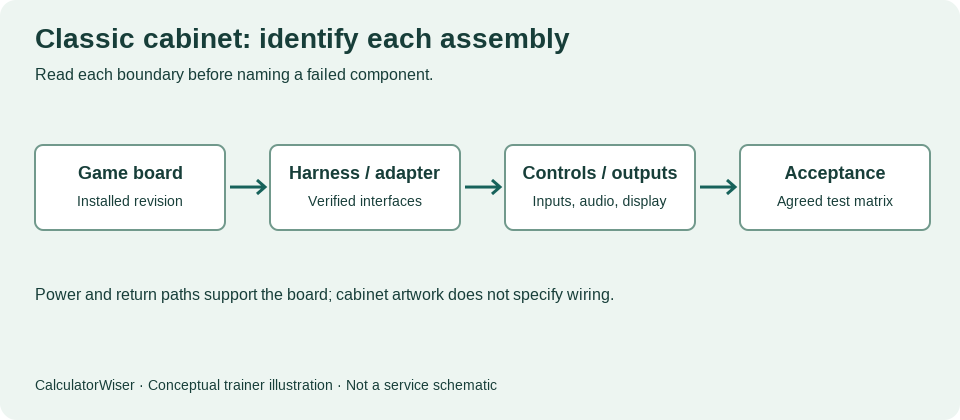
A successful restoration should recover an agreed experience without erasing evidence of the original configuration. Reliability, control feel, image, sound and cabinet safety need separate acceptance criteria. Historical authenticity and everyday usability can conflict; record reversible changes and preserve original parts where appropriate. A repair log should explain the decision, not just list the replacements.
Diagnostic method
Prepare a portfolio from the fictional cases in this track. Include an assembly inventory, fault timeline, competing hypotheses, selected evidence, qualified-service boundaries and acceptance plan. Use licensed software and documented board configurations. A practical sign-off for mains wiring, monitor safety and protective systems must come from qualified service; a written course score cannot establish hands-on competence.
Case study: read the evidence
A converted cabinet has a repaired connector and new joystick. It runs for five minutes and the invoice says 'fully restored.' Nobody checked input mapping, all game modes, sound settings or the previous warm-fault condition.
Reveal the diagnostic reasoning
The result is an initial functional observation. It does not satisfy a complete acceptance plan. Specify tests that reflect the reported faults and installed assemblies, with an appropriate supervised operating assessment and clear stop conditions. Do not equate a longer run with a substitute for safety inspection.
Your practical or paper exercise
Build an acceptance matrix with rows for identity, documented electrical inspection, controls, credits, audio, image, settings and repeatability. Mark each pass, fail or not tested.
Notes stay in this browser. They are not submitted to CalculatorWiser.
Compare with the worked answer
The matrix must preserve 'not tested' when evidence is absent and name the reviewer for qualified checks. Include configuration backups and unresolved limitations in the handover.
Repair evidence worksheet
For this case, record: equipment identity; exact symptom; expected behavior and source of that expectation; competing causes; evidence for and against each; next safe step; qualified-service needs; parts justification; acceptance criteria and remaining unknowns.
References and original manuals
Lessons and fictional cases are original. These links provide further reading, not permission to copy or resell manuals. A manual for another chassis or controller is not a substitute for the installed model’s service documents. Historic procedures may not meet present safety practice. No external document loads automatically.
Save to Pinterest