CalculatorWiser / Forgotten technology
Legacy Repair Workshop
Understand the fault. Preserve the evidence. Restore with a plan.
Progress can be saved in this browser when JavaScript and local storage are available.
Vintage RC Controls & Brushed Drive Systems
Legacy AM/FM crystal radios, mechanical speed controls, brushed drive and older reversible ESCs.
Preserve older RC equipment while separating compatibility, setup, wear and electrical faults. Brushed motors and servos still exist today; this track concerns their vintage installations.
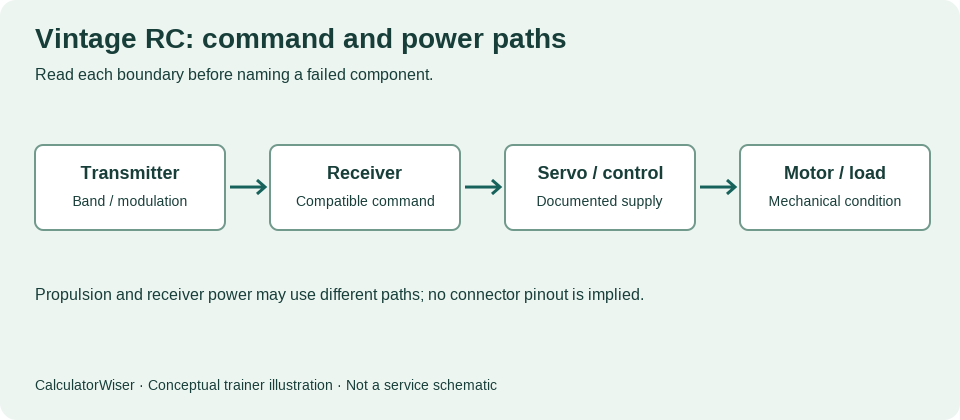
- Legacy AM/FM radio identity and crystal compatibility
A vintage receiver and transmitter both show the same channel number, but one is marked AM and the other FM. A learner plans to troubleshoot the servo because it does not respond.
- Mechanical speed controls: contacts, resistors and failsafe limits
A fictional series resistor is 0.5 Ω and carries 4 A during a specified trainer condition. It becomes hot, and the owner assumes every warm resistor is defective.
- Brushed motor wear versus drivetrain load
A car slows and the controller becomes hot after a gear change. With power removed, the drivetrain now binds at one point in its rotation. The owner orders a higher-current ESC.
- Older reversible ESC: no reverse is not automatically a failed bridge
A recorded test says forward and steering work, but reverse does not. The transmitter throttle trim was changed after the last successful run, and no controller settings were recorded.
- Servo jitter and receiver-power brownouts
A fictional receiver is specified for 4.8–6.0 V in this exercise. Its supplied log shows 5.2 V idle and 3.6 V during a steering event, followed by a restart. The propulsion controller still has battery power.
- Diode-mode comparison, protection and final vintage RC assessment
A supplied loose silicon-diode exercise reports 0.62 V in one direction and over-range in the other. A second loose diode reads close to zero in both directions after lead integrity is checked.
No matching lessons. Try a shorter symptom.
Track portfolio
Submit to your own study notebook: one identity sheet, six completed exercises, a fault tree with at least two competing explanations, and an acceptance matrix. Self-review each item for accurate units, evidence, assumptions and qualified-service boundaries. The portfolio is self-assessed.
References and original manuals
Lessons and fictional cases are original. These links provide further reading, not permission to copy or resell manuals. A manual for another chassis or controller is not a substitute for the installed model’s service documents. Historic procedures may not meet present safety practice. No external document loads automatically.
Save to Pinterest