CalculatorWiser / Forgotten technology
Legacy Repair Workshop
Understand the fault. Preserve the evidence. Restore with a plan.
Progress can be saved in this browser when JavaScript and local storage are available.
Tube Television Restoration / Lesson 2 of 6
Heater circuits: one dark tube is not a diagnosis
Understand the system
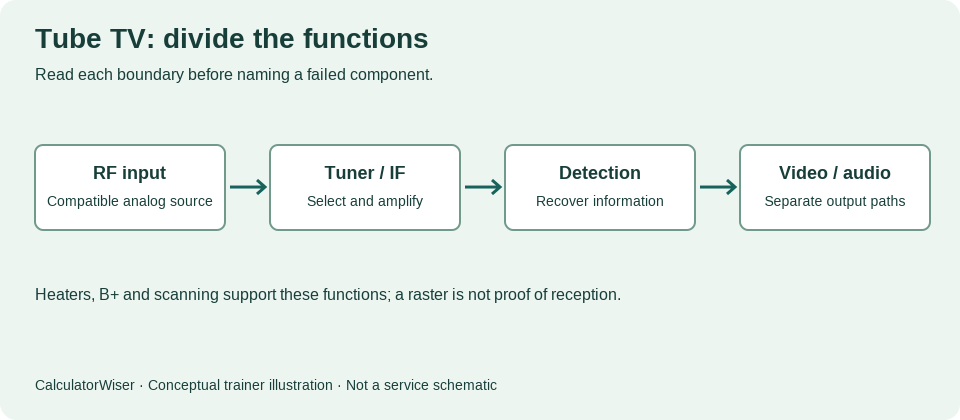
A heater warms a cathode so the tube can emit electrons. Heater continuity and electron emission are different properties. In a series string, an open heater or connection can interrupt the whole string. Parallel heaters behave differently. Some heaters are difficult to see, so absence of visible glow is weak evidence. The schematic, heater ratings and circuit topology determine what a symptom means.
Diagnostic method
Trace a printed heater circuit without touching equipment. In a series example, list every element in the path, including resistors, thermistors and connectors. In a parallel example, identify the common source and individual branches. Compare predictions for one open branch. For loose, positively identified training parts only, an instructor can demonstrate a continuity check with all energy sources removed. Meter resistance cannot tell you whether a tube will work correctly at operating temperature.
Case study: read the evidence
A fictional set has no visible heater glow anywhere. Its diagram shows a series string. A learner orders a full set of tubes.
Reveal the diagnostic reasoning
One open point could interrupt every heater, so replacing all tubes is unsupported. Consider the supply path, a single open heater, a socket contact and the switch. Establish the circuit topology before ranking these possibilities. A separate defect in B+ can coexist, and a repaired heater chain is not authorization to operate a deteriorated chassis.
Your practical or paper exercise
On paper, calculate the total specified voltage of heaters rated 12 V, 18 V, 25 V and 35 V. Explain why their current ratings must also agree in a series design.
Notes stay in this browser. They are not submitted to CalculatorWiser.
Compare with the worked answer
The voltage sum is 90 V. That arithmetic is a teaching example, not a proposed mains circuit. Series elements carry the same current; voltage totals alone do not establish compatibility.
Repair evidence worksheet
For this case, record: equipment identity; exact symptom; expected behavior and source of that expectation; competing causes; evidence for and against each; next safe step; qualified-service needs; parts justification; acceptance criteria and remaining unknowns.
References and original manuals
Lessons and fictional cases are original. These links provide further reading, not permission to copy or resell manuals. A manual for another chassis or controller is not a substitute for the installed model’s service documents. Historic procedures may not meet present safety practice. No external document loads automatically.
Save to Pinterest