CalculatorWiser / Forgotten technology
Legacy Repair Workshop
Understand the fault. Preserve the evidence. Restore with a plan.
Progress can be saved in this browser when JavaScript and local storage are available.
Classic Arcade Cabinet & Logic Repair / Lesson 4 of 6
Garbage graphics, reset and memory: rank the evidence
Understand the system
Repeated reset and corrupted graphics are symptoms shared by power, timing, interconnect and logic faults. A screen full of repeated characters does not identify a particular RAM chip. Self-test results are useful evidence, but their interpretation depends on the board revision and manual. A reset line changing state may be a response to a fault rather than its root cause.
Diagnostic method
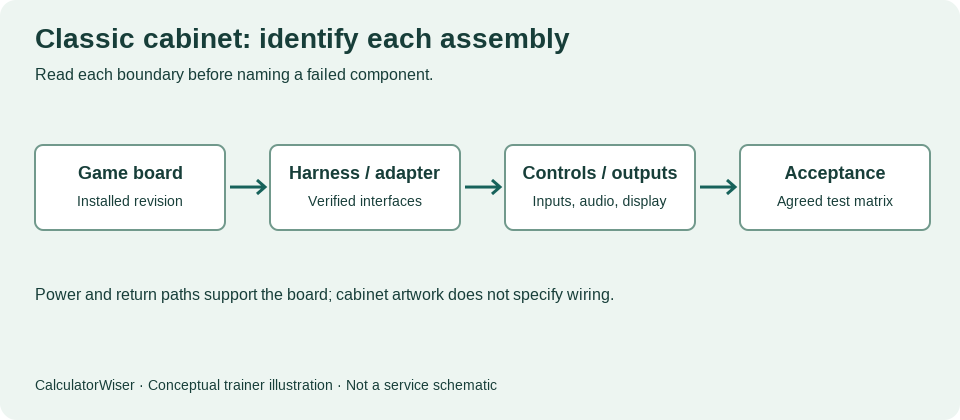
Start with a paper fault tree. Put verified power and documented configuration ahead of speculative chip replacement. Read an instructor-supplied self-test report and mark whether it names a location, bank or test stage. Preserve socket orientation and board provenance; do not remove chips or experiment with live logic probes without qualified supervision and correct tool ratings. Replacing a ROM with unverified software introduces compatibility and licensing questions.
Case study: read the evidence
A fictional board resets when a sound event occurs. A screenshot also shows a memory error after the restart. The supply path has not been assessed under the relevant load condition.
Reveal the diagnostic reasoning
A load-dependent power disturbance can corrupt execution and produce misleading downstream symptoms. It is a hypothesis to test through qualified measurement, not a proved cause. Preserve the self-test code and compare it to the exact manual, but do not leap from the code to replacing every memory device.
Your practical or paper exercise
Rank four next questions: power stability, exact self-test meaning, recent modifications and suspected chip part number. Explain why a parts order comes later.
Notes stay in this browser. They are not submitted to CalculatorWiser.
Compare with the worked answer
The first three gather evidence that can change the diagnosis. A suspected part number alone does not establish failure. Several rank orders are defensible if their reasoning is explicit.
Repair evidence worksheet
For this case, record: equipment identity; exact symptom; expected behavior and source of that expectation; competing causes; evidence for and against each; next safe step; qualified-service needs; parts justification; acceptance criteria and remaining unknowns.
References and original manuals
Lessons and fictional cases are original. These links provide further reading, not permission to copy or resell manuals. A manual for another chassis or controller is not a substitute for the installed model’s service documents. Historic procedures may not meet present safety practice. No external document loads automatically.
Save to Pinterest