CalculatorWiser / Forgotten technology
Legacy Repair Workshop
Understand the fault. Preserve the evidence. Restore with a plan.
Progress can be saved in this browser when JavaScript and local storage are available.
Tube Television Restoration / Lesson 4 of 6
Paper capacitors, resistor drift and replacement decisions
Understand the system
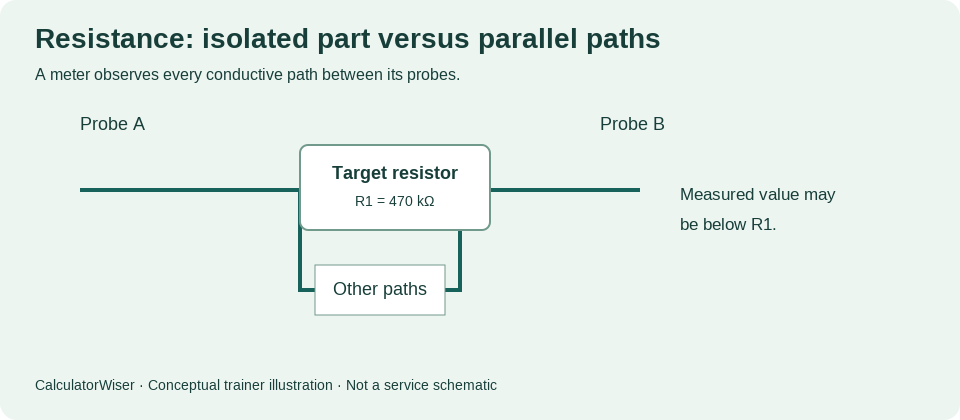
Aged components fail in different ways. A capacitor may leak electrically without an obvious bulge, while a resistor may drift without looking burned. A capacitance reading near the printed value does not prove acceptable leakage at operating voltage. Likewise, a low in-circuit resistance can be caused by parallel paths. Preservation requires recording what was fitted, why a change is justified and how the replacement preserves the circuit's requirements.
Diagnostic method
Study removed training parts and their markings. Record value, tolerance, voltage or power rating, polarity where applicable, location and safety role. For a disconnected loose resistor, compare measured resistance with the tolerance band. For a capacitor, distinguish capacitance, leakage, ESR and dielectric suitability; no single test covers all four. A model-specific restoration plan may justify replacing a class of deteriorated parts, but that plan must preserve safety classifications and circuit function. Do not select a capacitor solely by physical size.
Case study: read the evidence
A fictional 470 kΩ resistor with ±10% tolerance measures 560 kΩ out of circuit on a verified meter. Another marked 470 kΩ measures 310 kΩ while still connected across a network.
Reveal the diagnostic reasoning
The first lies above its nominal tolerance range. The second is inconclusive because the rest of the network can reduce the apparent resistance. Record isolation conditions before labeling either component. Replacing a part does not eliminate the need to investigate why it was stressed.
Your practical or paper exercise
Calculate the acceptable nominal tolerance interval for 470 kΩ ±10%. Classify the two observations without claiming that either proves the whole set safe.
Notes stay in this browser. They are not submitted to CalculatorWiser.
Compare with the worked answer
The interval is 423–517 kΩ. An isolated 560 kΩ is outside that interval; a 310 kΩ in-circuit result requires additional interpretation.
Repair evidence worksheet
For this case, record: equipment identity; exact symptom; expected behavior and source of that expectation; competing causes; evidence for and against each; next safe step; qualified-service needs; parts justification; acceptance criteria and remaining unknowns.
References and original manuals
Lessons and fictional cases are original. These links provide further reading, not permission to copy or resell manuals. A manual for another chassis or controller is not a substitute for the installed model’s service documents. Historic procedures may not meet present safety practice. No external document loads automatically.
Save to Pinterest