Car Radio Repair Masterclass
Vintage tube and hybrid radios, transistor receivers with cassette or CD mechanisms, and modern head units with vehicle integration. Learn to identify the design, distinguish faults and prepare a documented repair plan.
Modern Head Units & Vehicle Integration
Bluetooth, USB, phone integration, firmware, factory amplifiers and retained vehicle functions.
System map and practical route
Original course study map. Connector assignments, voltage limits and service procedures must come from the exact model manual.
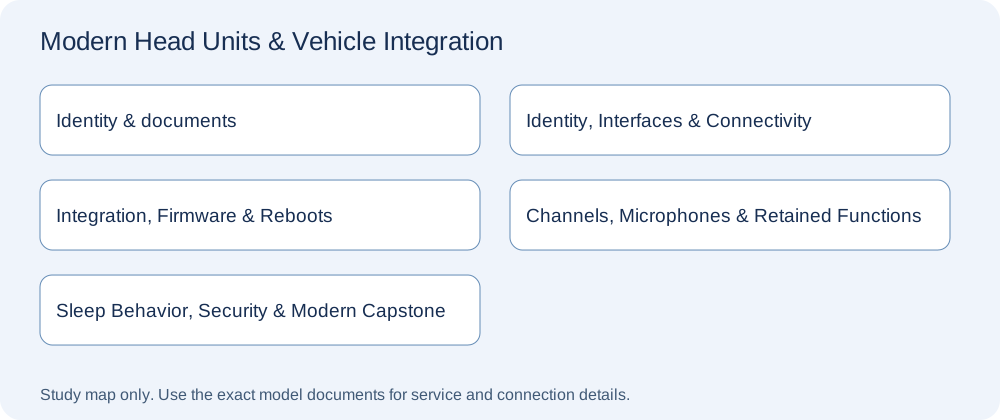
Begin with the two free previews. Work through the mini courses, keep a repair-planning portfolio, then submit the capstone worksheet for qualified review. Quizzes record written learning only.
Identity, Interfaces & Connectivity
Four original written lessons with learner Q&A, a diagnostic checklist, fictional cases and verification tasks.
4 lessons • included in this full track and the complete program
Open mini course →View price & enrollIntegration, Firmware & Reboots
Four original written lessons with learner Q&A, a diagnostic checklist, fictional cases and verification tasks.
4 lessons • included in this full track and the complete program
Open mini course →View price & enrollChannels, Microphones & Retained Functions
Four original written lessons with learner Q&A, a diagnostic checklist, fictional cases and verification tasks.
4 lessons • included in this full track and the complete program
Open mini course →View price & enrollSleep Behavior, Security & Modern Capstone
Four original written lessons with learner Q&A, a diagnostic checklist, fictional cases and verification tasks.
4 lessons • included in this full track and the complete program
Open mini course →View price & enrollFind a car-radio lesson, symptom or question
Search titles and learner questions. Lesson access follows your existing mini-course, full-track or complete-program purchase.
- Free preview: Identify a modern head unit and integration adaptersIdentity, Interfaces & Connectivity • Free sample
- Free preview: Buttons, touchscreens and detachable panelsIdentity, Interfaces & Connectivity • Free sample
- Bluetooth calls versus music playbackIdentity, Interfaces & Connectivity • Included lesson
- USB playback, cables and supported formatsIdentity, Interfaces & Connectivity • Included lesson
- CarPlay and Android Auto compatibilityIntegration, Firmware & Reboots • Included lesson
- OEM amplifiers, mute states and enable conditionsIntegration, Firmware & Reboots • Included lesson
- Firmware identity and update planningIntegration, Firmware & Reboots • Included lesson
- Reboots, memory loss and supply conditionsIntegration, Firmware & Reboots • Included lesson
- One channel missing: routing or hardware?Channels, Microphones & Retained Functions • Included lesson
- Subwoofer routing and crossover settingsChannels, Microphones & Retained Functions • Included lesson
- Microphones, call echo and source-specific audioChannels, Microphones & Retained Functions • Included lesson
- Camera and steering-control retentionChannels, Microphones & Retained Functions • Included lesson
- Battery-drain complaints and sleep behaviorSleep Behavior, Security & Modern Capstone • Included lesson
- Water damage, corrosion and uneconomic repairsSleep Behavior, Security & Modern Capstone • Included lesson
- Lawful security-code and replacement proceduresSleep Behavior, Security & Modern Capstone • Included lesson
- Modern car-radio capstone and handoverSleep Behavior, Security & Modern Capstone • Included lesson
No matching lessons. Try a shorter symptom or circuit name.
Free preview: Identify a modern head unit and integration adapters
Learning goal: Explain identify a modern head unit and integration adapters and prepare an evidence-led diagnostic plan.
Modern receivers may depend on a vehicle-specific harness, amplifier interface or control adapter. Record receiver model, vehicle, adapter part and firmware where relevant. The radio and the vehicle system are separate identities. Retaining a display alone does not prove that all original functions remain supported.
Never assume physical fit or a seller's compatibility headline covers every vehicle option.
For the written exercise, identify the exact equipment and relevant documents. Separate recorded observations from assumptions, then list at least two plausible explanations and what would distinguish them. Do not invent measurements or apply a generic wiring assignment to customer equipment. Practical work requires suitable training and the model-specific procedure.
Diagnostic planning checklist
- Identify receiver, revision, vehicle or bench context and relevant accessories.
- Record the specific symptom, source and timing without inventing internal findings.
- Compare the documented design with at least two competing explanations.
- Name the evidence needed and the appropriate qualified or supervised assessment.
- Define verification for the original complaint and any agreed retained functions.
Questions learners ask
Does a working screen prove complete vehicle compatibility?
No. Audio and control integration must be checked separately.
What should the case report avoid?
For this lesson, avoid replacing documentation with the shortcut: Never assume physical fit or a seller's compatibility headline covers every vehicle option.
Car Radio service glossary
- ACC
- A documented ignition-related control function; not a universal wire assignment.
- AGC
- Automatic gain control in a receiver.
- AM
- Amplitude modulation; distinguish band reception from the audio output path.
- Antenna adapter
- An interface whose compatibility and any power requirements must be checked.
- B+
- An operating supply in tube circuitry; it can be hazardous despite a low-voltage input.
- Bias
- The operating condition of an active stage.
- Bridge output
- An output arrangement in which both load terminals can be driven.
- Buffer capacitor
- A circuit-specific component associated with switching-supply behavior.
- Chassis
- Receiver assembly or its identifier; not necessarily the cabinet or vehicle identity.
- Clipping
- Signal limitation that changes the intended waveform.
- Crossover
- Processing that distributes or limits frequency ranges.
- ESD
- Electrostatic discharge that can damage susceptible electronics.
- Fader
- Front/rear level relationship, where supported.
- FM
- Frequency modulation; its reception path can differ from AM.
- Ground polarity
- The documented relationship between the supply and reference chassis.
- Head unit
- The receiver/control assembly in a car audio system.
- IF
- Intermediate-frequency processing after frequency conversion.
- Line level
- A signal interface distinct from power speaker outputs.
- Mute
- A function that suppresses audio; its cause and control are design-specific.
- OEM
- Original-equipment manufacturer; installed options still need identification.
- Pinout
- Connector assignments for an exact model and revision.
- Remote enable
- A documented control condition for compatible external equipment.
- Ripple
- Variation on a supply level.
- Rollback
- A documented return to a known software or configuration state.
- Source chain
- All devices and connections between content and the receiver.
- Synchronous vibrator
- A historical vibrator arrangement including a rectifying function.
- Vibrator
- An electromechanical switching component used in some historical supplies.
- Voltage drop
- Difference across a current-carrying path due to its impedance.
Diagnostic case
A screen works after replacement, but factory sound and steering-wheel controls no longer respond.
Fictional training case; the observations are not measurements from your car radio.
Practice task / worksheet
Write a case report with identity, the complaint, two competing explanations, missing evidence, an approved assessment scope and verification criteria. Explain why the rejected shortcut would not establish a reliable diagnosis.
Printable diagnostic worksheet
- Model, chassis and revision
- _______________________________
- Symptom and when it occurs
- _______________________________
- Evidence versus assumptions
- _______________________________
- Three competing hypotheses
- _______________________________
- Documentation and qualified assessment required
- _______________________________
- Approved scope and verification criteria
- _______________________________
Check your reasoning
Does a working screen prove complete vehicle compatibility?
No. Audio and control integration must be checked separately. The goal is a supported conclusion, with uncertainty preserved where evidence is missing.
References and further reading
Original written lessons and fictional diagnostic cases. Manufacturer service procedures must be obtained for the exact equipment; linked manuals are not resold as course downloads.
Save to Pinterest