Electronic Components & Circuits
A broad reference to parts, instruments and circuit functions, explained in everyday language with labeled illustrations, examples and specification checks.
How to use this list
Open an entry to see its illustration, what it does, an example and the specifications that matter. Tap any image to enlarge it. Images are original representative illustrations, not photographs, exact pinouts or guarantees of physical identification. Component families and circuit arrangements are distinct: a capacitor is a part; a filter is a circuit that may use several parts. This reference covers common and important families, rather than every manufacturer part number or specialized circuit ever made.
Examples explain function; they are not universal replacement or wiring instructions. Appearance, package size and a matching nominal value do not establish compatibility. Stored charge, mains, vehicle batteries and high-voltage equipment require appropriate precautions and qualified procedures.
Search the free reference
15 of 160 entries shown. Search matches all entered words across names and explanations.
Browse by category
ADC and DACIntegrated Circuits
What it does
An ADC converts an analog input into digital information; a DAC converts digital information into an analog output.
Example
Sensor measurement or audio conversion.
Important distinction
Resolution is not the same as total accuracy, bandwidth or noise performance.
Specifications to read
Exact part/revision, pinout, supply, input/output ranges, timing, interface, thermal limits and required surrounding parts.
A rating is a limit or condition, not a guarantee of suitability. Use the manufacturer's data sheet for the exact component and the equipment's schematic for its intended role.
Analog switch and multiplexerIntegrated Circuits
What it does
Routes suitable signals under control of its supported logic interface.
Example
Selecting sensor inputs.
Important distinction
Signal range, on-resistance and leakage constrain use.
Specifications to read
Exact part/revision, pinout, supply, input/output ranges, timing, interface, thermal limits and required surrounding parts.
A rating is a limit or condition, not a guarantee of suitability. Use the manufacturer's data sheet for the exact component and the equipment's schematic for its intended role.
Audio, motor and interface driver ICIntegrated Circuits
What it does
Provides application-specific drive or communication functions rather than a universal amplification role.
Example
An audio output, motor stage or serial interface.
Important distinction
Choose by the exact circuit function, protection and interface requirements.
Specifications to read
Exact part/revision, pinout, supply, input/output ranges, timing, interface, thermal limits and required surrounding parts.
A rating is a limit or condition, not a guarantee of suitability. Use the manufacturer's data sheet for the exact component and the equipment's schematic for its intended role.
ComparatorIntegrated Circuits
What it does
Compares signals and changes its output according to their relationship under specified conditions.
Example
A threshold detector.
Important distinction
Output type and hysteresis requirements differ from those of an op-amp circuit.
Specifications to read
Exact part/revision, pinout, supply, input/output ranges, timing, interface, thermal limits and required surrounding parts.
A rating is a limit or condition, not a guarantee of suitability. Use the manufacturer's data sheet for the exact component and the equipment's schematic for its intended role.
DSPIntegrated Circuits
What it does
A processing device or function optimized for digital signal operations.
Example
Audio filtering or communications processing.
Important distinction
Its code, data format and interfaces are part of the implemented system.
Specifications to read
Exact part/revision, pinout, supply, input/output ranges, timing, interface, thermal limits and required surrounding parts.
A rating is a limit or condition, not a guarantee of suitability. Use the manufacturer's data sheet for the exact component and the equipment's schematic for its intended role.
EEPROM, flash and RAM distinctionsIntegrated Circuits
What it does
EEPROM and flash are nonvolatile technologies; RAM provides working storage in applicable designs.
Example
Configuration, program or working data.
Important distinction
Interface, organization and write behavior are technology-specific.
Specifications to read
Exact part/revision, pinout, supply, input/output ranges, timing, interface, thermal limits and required surrounding parts.
A rating is a limit or condition, not a guarantee of suitability. Use the manufacturer's data sheet for the exact component and the equipment's schematic for its intended role.
FPGA and programmable logicIntegrated Circuits
What it does
Devices whose digital logic arrangement is configured for an application.
Example
A specialized controller or signal processor.
Important distinction
Configuration and compatible electrical interfaces are required; package fit is insufficient.
Specifications to read
Exact part/revision, pinout, supply, input/output ranges, timing, interface, thermal limits and required surrounding parts.
A rating is a limit or condition, not a guarantee of suitability. Use the manufacturer's data sheet for the exact component and the equipment's schematic for its intended role.
Linear regulator and LDOIntegrated Circuits
What it does
Controls an output supply using a linear pass arrangement. An LDO can operate with a relatively small specified input-output difference.
Example
A low-noise supply rail.
Important distinction
Dropout, heat, load and capacitor requirements still apply.
Specifications to read
Exact part/revision, pinout, supply, input/output ranges, timing, interface, thermal limits and required surrounding parts.
A rating is a limit or condition, not a guarantee of suitability. Use the manufacturer's data sheet for the exact component and the equipment's schematic for its intended role.
Logic gateIntegrated Circuits
What it does
Implements a Boolean function such as AND, OR, NOT, NAND or XOR.
Example
Combining digital control conditions.
Important distinction
Logic voltage families and input thresholds must be compatible.
Specifications to read
Exact part/revision, pinout, supply, input/output ranges, timing, interface, thermal limits and required surrounding parts.
A rating is a limit or condition, not a guarantee of suitability. Use the manufacturer's data sheet for the exact component and the equipment's schematic for its intended role.
Memory ICIntegrated Circuits
What it does
Stores program, working or nonvolatile information, depending on technology.
Example
RAM, flash or an EEPROM configuration store.
Important distinction
Package fit does not establish interface, voltage or data compatibility.
Specifications to read
Exact part/revision, pinout, supply, input/output ranges, timing, interface, thermal limits and required surrounding parts.
A rating is a limit or condition, not a guarantee of suitability. Use the manufacturer's data sheet for the exact component and the equipment's schematic for its intended role.
MicrocontrollerIntegrated Circuits
What it does
Combines processing, memory and peripherals for programmed control.
Example
A display controller or embedded instrument.
Important distinction
Firmware and peripheral configuration are part of the system behavior.
Specifications to read
Exact part/revision, pinout, supply, input/output ranges, timing, interface, thermal limits and required surrounding parts.
A rating is a limit or condition, not a guarantee of suitability. Use the manufacturer's data sheet for the exact component and the equipment's schematic for its intended role.
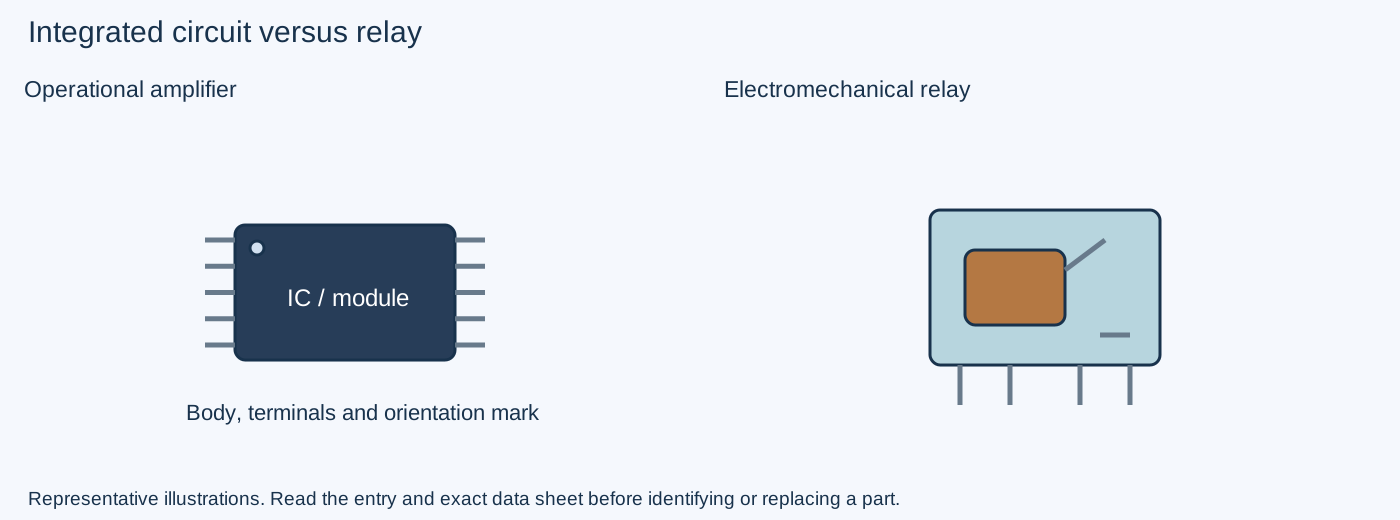
Operational amplifierIntegrated Circuits
What it does
An analog amplifier with differential inputs, commonly used with feedback to establish a controlled circuit function.
Example
A sensor buffer or active filter.
Important distinction
Input range, supply limits, stability and output capability constrain real devices.
Specifications to read
Exact part/revision, pinout, supply, input/output ranges, timing, interface, thermal limits and required surrounding parts.
A rating is a limit or condition, not a guarantee of suitability. Use the manufacturer's data sheet for the exact component and the equipment's schematic for its intended role.
Switching-regulator ICIntegrated Circuits
What it does
Controls switching energy conversion, often with external magnetic and passive components.
Example
A buck, boost or other converter.
Important distinction
Topology, compensation, layout and protection must work together.
Specifications to read
Exact part/revision, pinout, supply, input/output ranges, timing, interface, thermal limits and required surrounding parts.
A rating is a limit or condition, not a guarantee of suitability. Use the manufacturer's data sheet for the exact component and the equipment's schematic for its intended role.
Timer ICIntegrated Circuits
What it does
Combines timing-related functions in an integrated device; some familiar types use external resistors and capacitors.
Example
A pulse or timing circuit.
Important distinction
Use the actual device's modes and limits rather than a universal pin diagram.
Specifications to read
Exact part/revision, pinout, supply, input/output ranges, timing, interface, thermal limits and required surrounding parts.
A rating is a limit or condition, not a guarantee of suitability. Use the manufacturer's data sheet for the exact component and the equipment's schematic for its intended role.
Voltage referenceIntegrated Circuits
What it does
Provides a specified reference level for suitable measurement or control arrangements.
Example
An ADC reference input.
Important distinction
Accuracy, load, temperature behavior and noise affect the result.
Specifications to read
Exact part/revision, pinout, supply, input/output ranges, timing, interface, thermal limits and required surrounding parts.
A rating is a limit or condition, not a guarantee of suitability. Use the manufacturer's data sheet for the exact component and the equipment's schematic for its intended role.
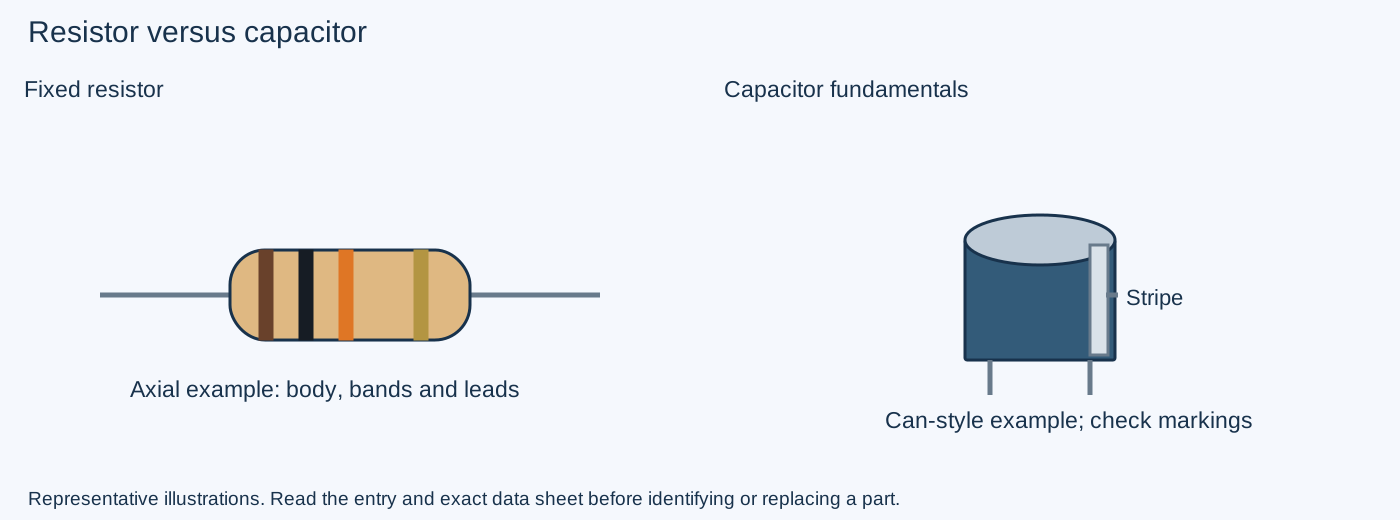
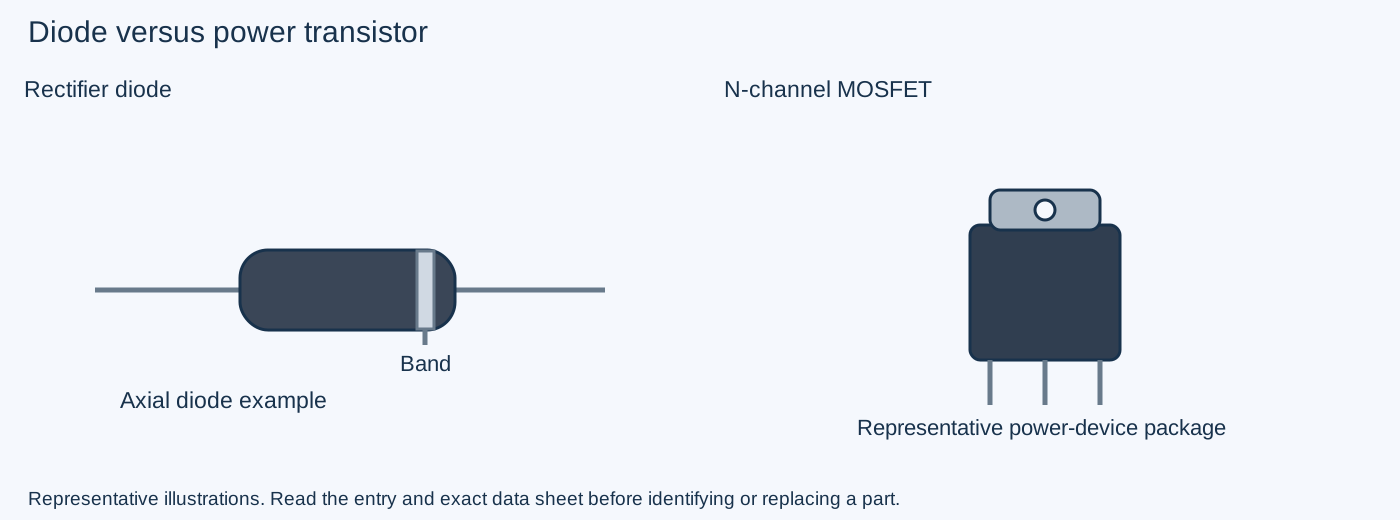
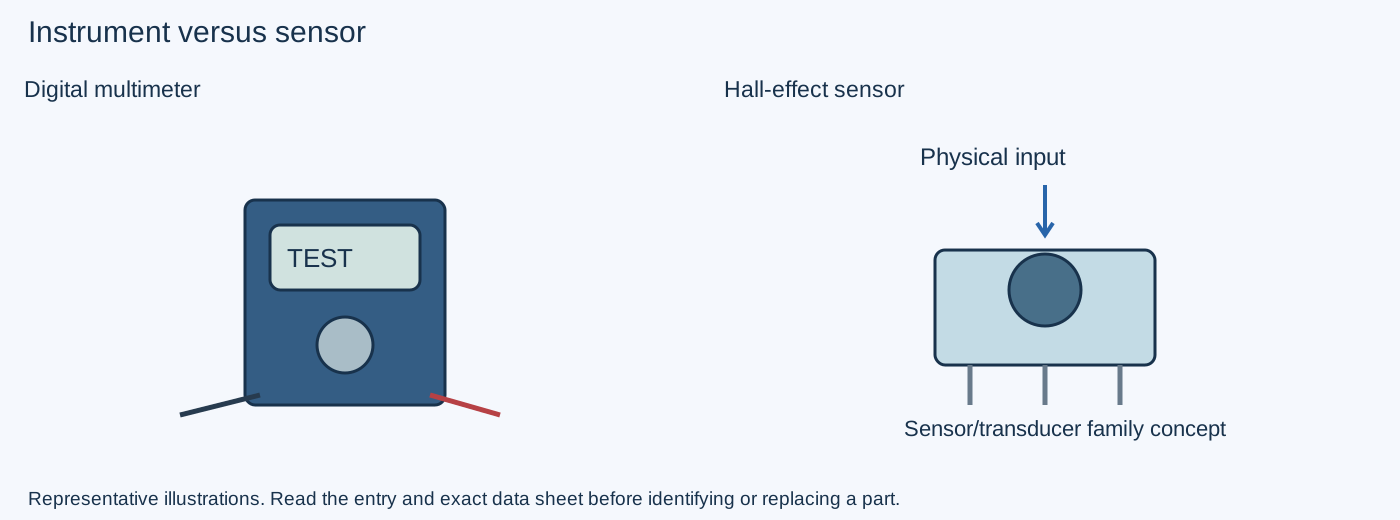
Visual comparison guides
Compare representative physical forms, then read the entries for their different functions. Many parts share package shapes. Appearance alone cannot identify ratings, internal construction or terminal assignments.
Units and worked examples
| Quantity | Unit | Meaning |
|---|---|---|
| Voltage | V, volts | Potential difference between two points. |
| Current | A, amperes | Rate of charge flow. |
| Resistance | Ω, ohms | Resistance to current flow. |
| Power | W, watts | Rate of energy transfer or dissipation. |
| Capacitance | F, farads | Charge change per voltage change. |
| Inductance | H, henries | Relationship between current change and induced voltage. |
| Frequency | Hz, hertz | Cycles per second. |
Prefixes: k = 1,000; M = 1,000,000; m = 0.001; μ = 0.000001; n = 0.000000001; p = 0.000000000001. Case matters: M and m are different.
Resistor example
For an ideal 1 kΩ resistor with 5 V across it: I = V/R = 5/1,000 = 0.005 A = 5 mA. Dissipation is P = V²/R = 25/1,000 = 0.025 W. This arithmetic does not select a real part without its temperature, voltage and application requirements.
Tolerance example
A 1 kΩ resistor with ±5% nominal tolerance spans 950 Ω to 1,050 Ω at the specified conditions. Tolerance is different from drift with temperature or aging.
Capacitance and timing example
10 μF = 10,000 nF. An ideal first-order RC network with R = 1 kΩ and C = 10 μF has τ = RC = 0.01 s = 10 ms. A time constant is not automatically the delay of every timer using those parts.
Stored energy
Ideal capacitor charge is Q = CV; stored energy is E = ½CV². Doubling voltage at the same capacitance quadruples the stored energy. These are learning equations, not a discharge procedure.
Schematic symbols, labels and markings
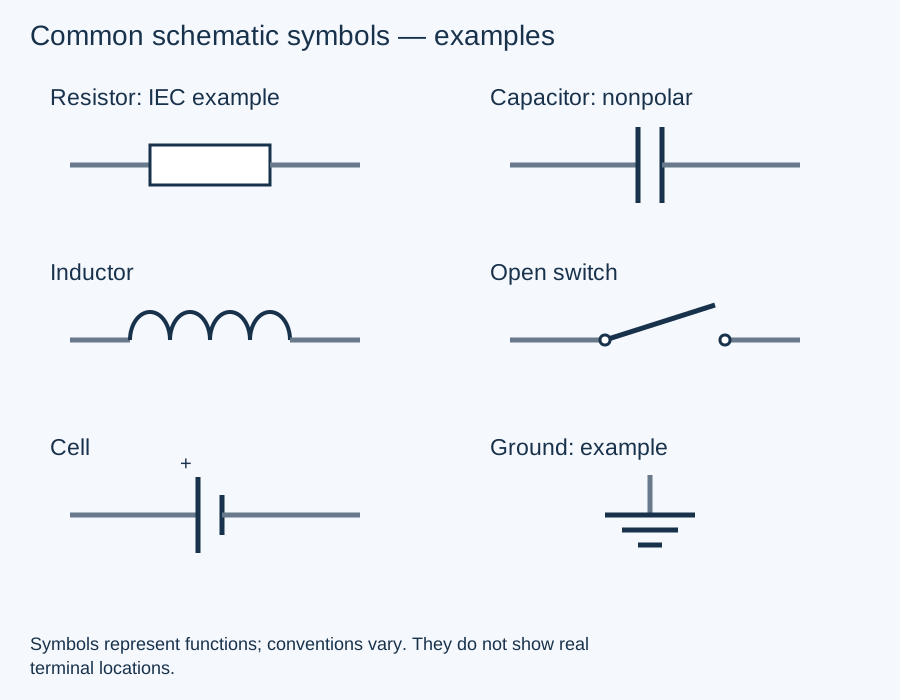
Reference letters identify components in a drawing; conventions vary by manufacturer and standard. Always read the drawing's legend.
| Common label | Often used for |
|---|---|
| R | Resistor |
| C | Capacitor |
| L | Inductor |
| D | Diode |
| Q | Transistor |
| U / IC | Integrated circuit |
| T | Transformer |
| K / RL | Relay |
| SW / S | Switch |
| J / P / CN | Connector |
| F | Fuse |
| Y / X | Crystal or resonator |
| TP | Test point |
| V / VT | Tube in some historical documentation |
R17 identifies a component location, not a resistance value. A marking such as 4R7 may mean 4.7 Ω in an applicable resistor convention. Three-digit markings such as 104 often represent 100,000 base units: 100 kΩ for a resistor or 100,000 pF = 100 nF for an applicable capacitor code. Confirm the component family and marking system; short codes can be ambiguous.
Common questions
Can I replace a part with any higher-rated one?
No. A higher headline rating does not ensure suitable function, polarity, frequency behavior, package, protective approval or circuit stability.
Does a part that looks normal have to be good?
No. Visual observations can help, but many electrical changes leave no obvious external sign.
Are capacitance, ESR and leakage the same?
No. They describe different properties. A single test cannot establish every capacitor failure mode.
Can I measure every component while it remains connected?
Other paths can affect an in-circuit result. Interpretation depends on the circuit and instrument. Internal work also requires a suitable qualified safety procedure.
Does a matching package establish a transistor or IC replacement?
No. Pinout, function, voltage, drive, timing, heat and application requirements must match.
Is a component the same thing as a circuit?
A component is a building block. A circuit connects building blocks to perform a function. The same component family can serve many circuit roles.
How do I begin learning?
Start with units, schematic labels, resistor/capacitor/inductor functions and signal-versus-power paths. Use disconnected parts or an instructor-approved low-voltage trainer before considering customer equipment.
Is this reference free?
Yes. Every entry, example and reference on this page is public. The separate repair masterclasses have their own free previews and paid lessons.
Manufacturer references
Original plain-language summaries and educational examples. These references support further study; exact product data sheets and equipment manuals remain authoritative for a real application.
Save to Pinterest