Electronic Components & Circuits
A broad reference to parts, instruments and circuit functions, explained in everyday language with labeled illustrations, examples and specification checks.
How to use this list
Open an entry to see its illustration, what it does, an example and the specifications that matter. Tap any image to enlarge it. Images are original representative illustrations, not photographs, exact pinouts or guarantees of physical identification. Component families and circuit arrangements are distinct: a capacitor is a part; a filter is a circuit that may use several parts. This reference covers common and important families, rather than every manufacturer part number or specialized circuit ever made.
Examples explain function; they are not universal replacement or wiring instructions. Appearance, package size and a matching nominal value do not establish compatibility. Stored charge, mains, vehicle batteries and high-voltage equipment require appropriate precautions and qualified procedures.
Search the free reference
6 of 160 entries shown. Search matches all entered words across names and explanations.
Browse by category
CRTVacuum Tubes and Historical Parts
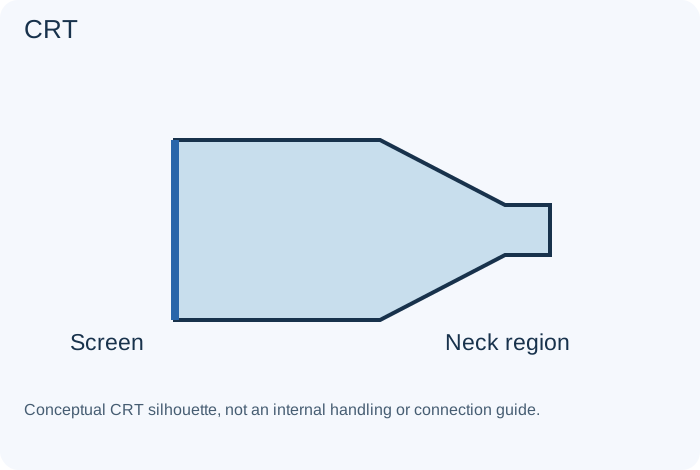
What it does
An electron-beam display with a phosphor screen and associated control/deflection systems.
Example
A television or arcade monitor.
Important distinction
Stored high voltage and fragile evacuated glass require qualified model-specific handling.
Specifications to read
Exact type, pinout, heater and operating requirements, circuit role and model-specific service data.
A rating is a limit or condition, not a guarantee of suitability. Use the manufacturer's data sheet for the exact component and the equipment's schematic for its intended role.
Rectifier tubeVacuum Tubes and Historical Parts
What it does
A tube selected to supply rectifying functions in a power arrangement.
Example
An older radio power supply.
Important distinction
Replacement can alter operating conditions; it is not merely a base-shape comparison.
Specifications to read
Exact type, pinout, heater and operating requirements, circuit role and model-specific service data.
A rating is a limit or condition, not a guarantee of suitability. Use the manufacturer's data sheet for the exact component and the equipment's schematic for its intended role.
Tetrode and pentodeVacuum Tubes and Historical Parts
What it does
Tube families with additional grid structures that affect their operating characteristics.
Example
A receiver or audio power stage.
Important distinction
Pinout and stage requirements must come from the exact tube and circuit data.
Specifications to read
Exact type, pinout, heater and operating requirements, circuit role and model-specific service data.
A rating is a limit or condition, not a guarantee of suitability. Use the manufacturer's data sheet for the exact component and the equipment's schematic for its intended role.
TriodeVacuum Tubes and Historical Parts
What it does
A thermionic tube with a control-grid function in addition to cathode and plate.
Example
A historical amplifier or oscillator.
Important distinction
A tube envelope may contain several sections with separate roles.
Specifications to read
Exact type, pinout, heater and operating requirements, circuit role and model-specific service data.
A rating is a limit or condition, not a guarantee of suitability. Use the manufacturer's data sheet for the exact component and the equipment's schematic for its intended role.
Vacuum diodeVacuum Tubes and Historical Parts
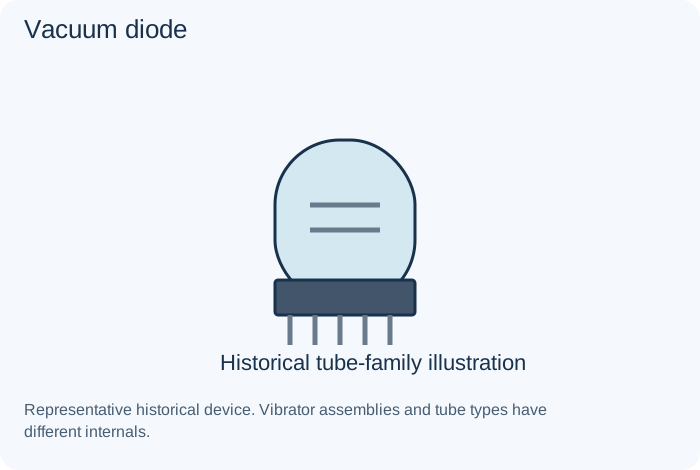
What it does
A thermionic two-electrode device that can rectify in its intended circuit.
Example
A historical receiver supply.
Important distinction
Heater and operating requirements differ from semiconductor diode requirements.
Specifications to read
Exact type, pinout, heater and operating requirements, circuit role and model-specific service data.
A rating is a limit or condition, not a guarantee of suitability. Use the manufacturer's data sheet for the exact component and the equipment's schematic for its intended role.
Vibrator unitVacuum Tubes and Historical Parts
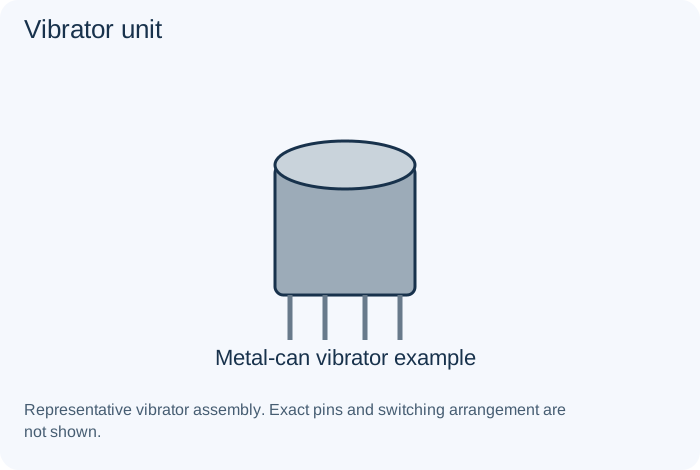
What it does
An electromechanical switching device used in some historical battery-powered supplies.
Example
A vintage car-radio supply.
Important distinction
Mechanical buzzing does not prove correct electrical output or suitability.
Specifications to read
Exact type, pinout, heater and operating requirements, circuit role and model-specific service data.
A rating is a limit or condition, not a guarantee of suitability. Use the manufacturer's data sheet for the exact component and the equipment's schematic for its intended role.
Visual comparison guides
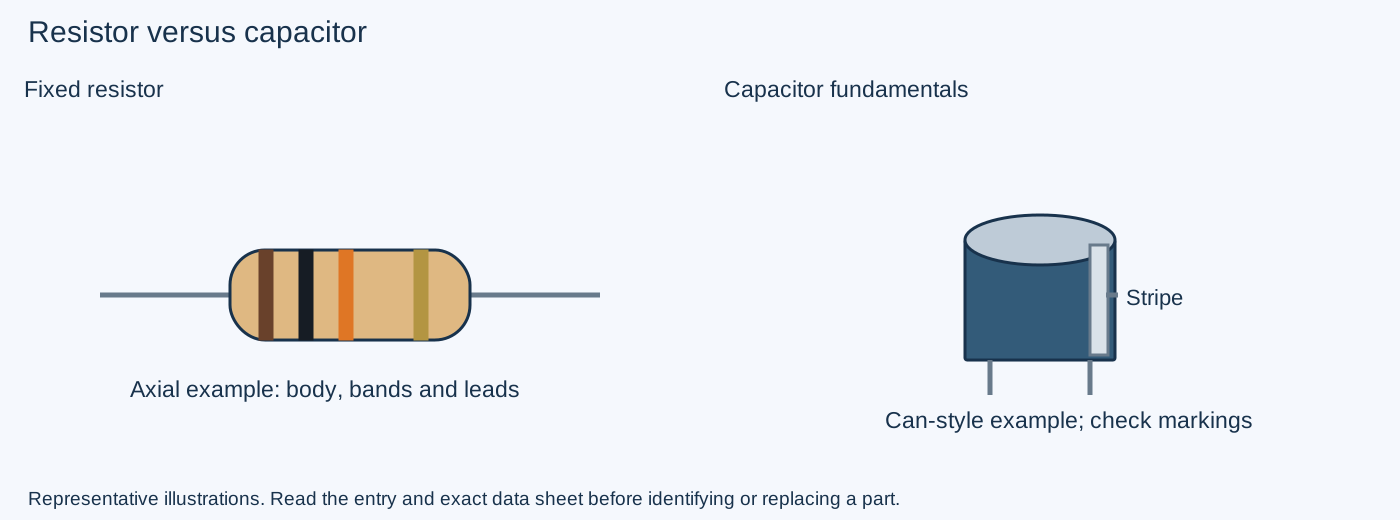
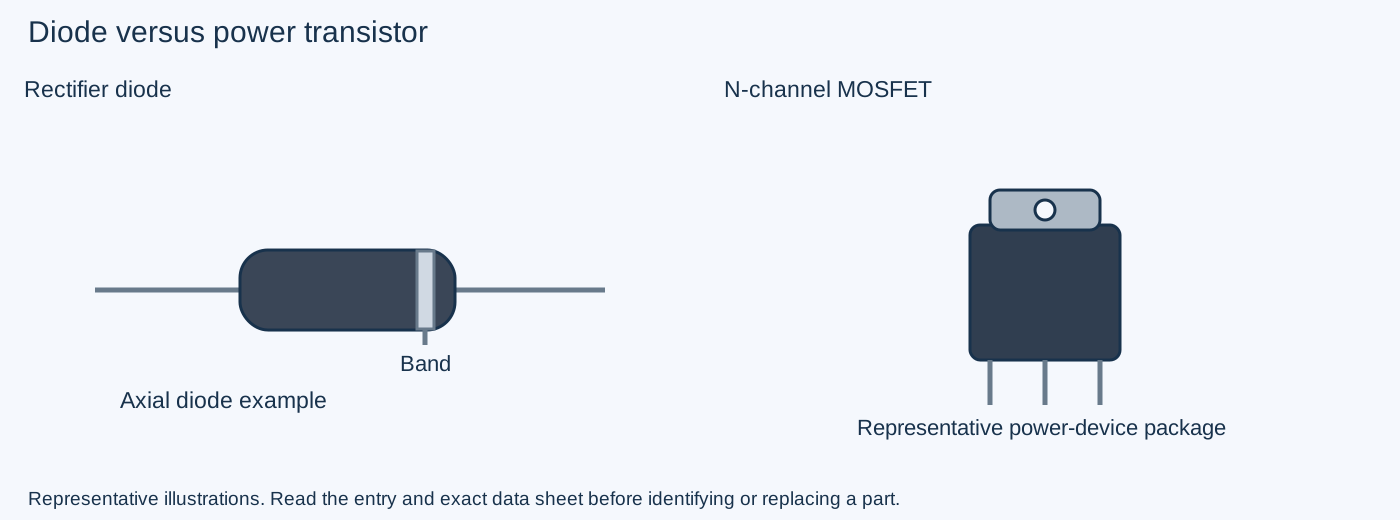
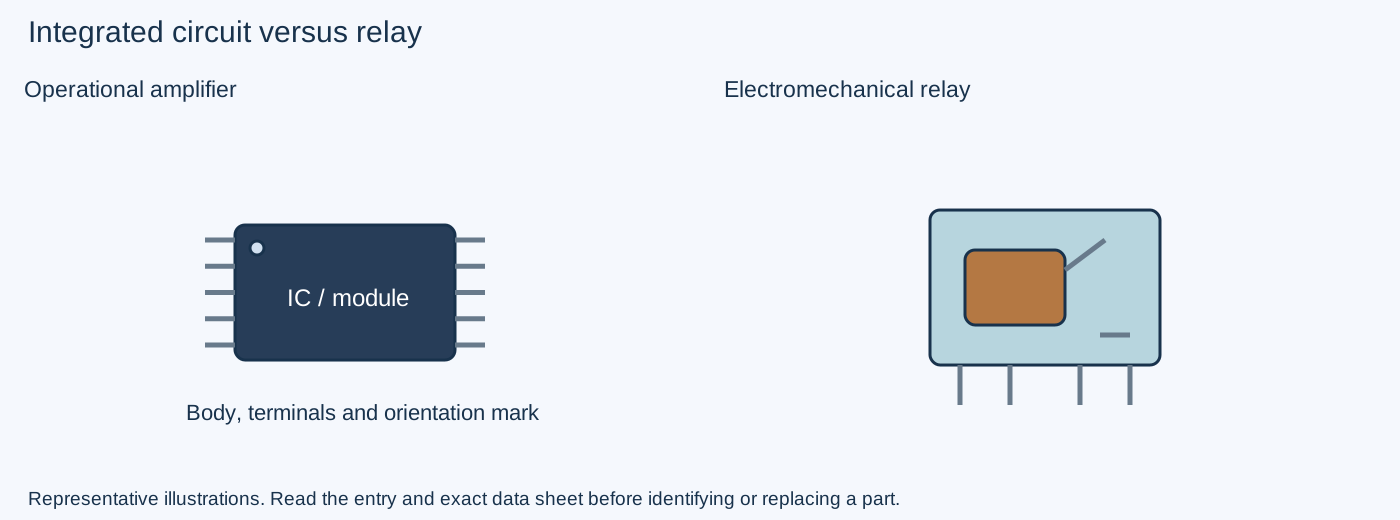
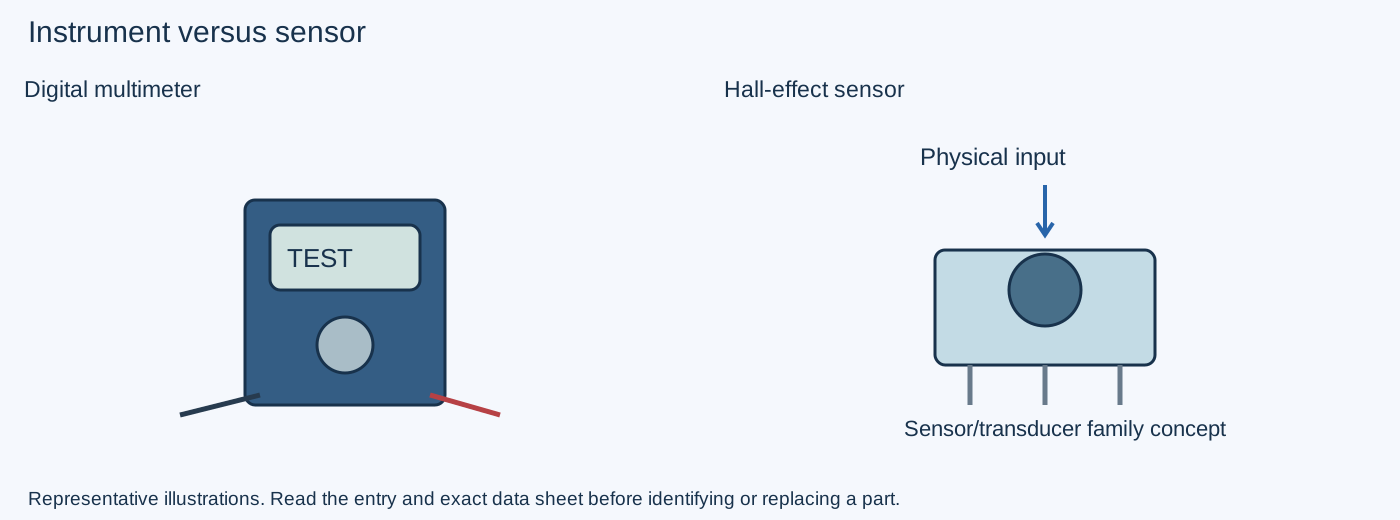
Compare representative physical forms, then read the entries for their different functions. Many parts share package shapes. Appearance alone cannot identify ratings, internal construction or terminal assignments.
Units and worked examples
| Quantity | Unit | Meaning |
|---|---|---|
| Voltage | V, volts | Potential difference between two points. |
| Current | A, amperes | Rate of charge flow. |
| Resistance | Ω, ohms | Resistance to current flow. |
| Power | W, watts | Rate of energy transfer or dissipation. |
| Capacitance | F, farads | Charge change per voltage change. |
| Inductance | H, henries | Relationship between current change and induced voltage. |
| Frequency | Hz, hertz | Cycles per second. |
Prefixes: k = 1,000; M = 1,000,000; m = 0.001; μ = 0.000001; n = 0.000000001; p = 0.000000000001. Case matters: M and m are different.
Resistor example
For an ideal 1 kΩ resistor with 5 V across it: I = V/R = 5/1,000 = 0.005 A = 5 mA. Dissipation is P = V²/R = 25/1,000 = 0.025 W. This arithmetic does not select a real part without its temperature, voltage and application requirements.
Tolerance example
A 1 kΩ resistor with ±5% nominal tolerance spans 950 Ω to 1,050 Ω at the specified conditions. Tolerance is different from drift with temperature or aging.
Capacitance and timing example
10 μF = 10,000 nF. An ideal first-order RC network with R = 1 kΩ and C = 10 μF has τ = RC = 0.01 s = 10 ms. A time constant is not automatically the delay of every timer using those parts.
Stored energy
Ideal capacitor charge is Q = CV; stored energy is E = ½CV². Doubling voltage at the same capacitance quadruples the stored energy. These are learning equations, not a discharge procedure.
Schematic symbols, labels and markings
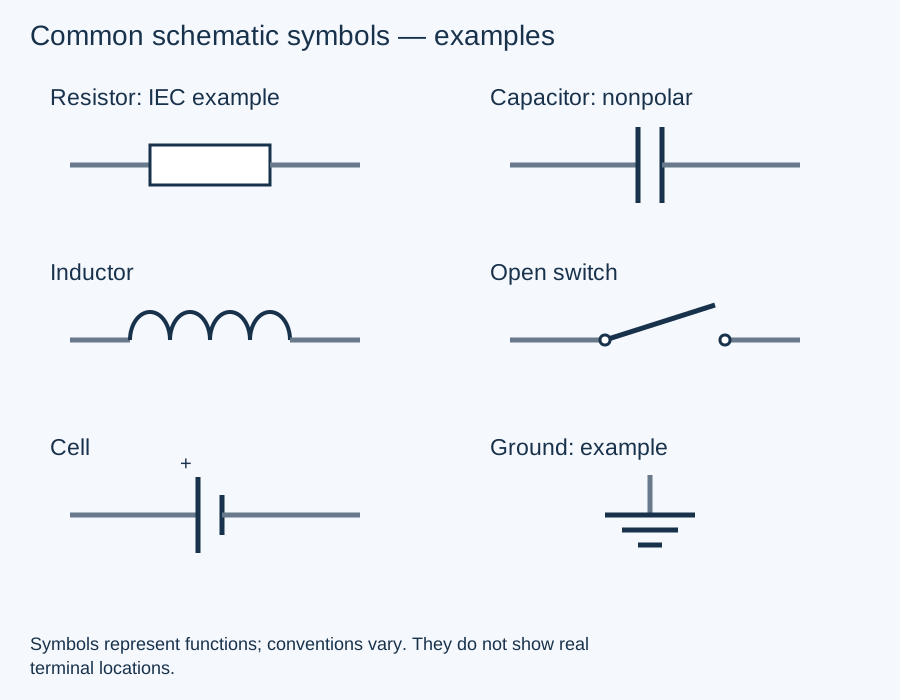
Reference letters identify components in a drawing; conventions vary by manufacturer and standard. Always read the drawing's legend.
| Common label | Often used for |
|---|---|
| R | Resistor |
| C | Capacitor |
| L | Inductor |
| D | Diode |
| Q | Transistor |
| U / IC | Integrated circuit |
| T | Transformer |
| K / RL | Relay |
| SW / S | Switch |
| J / P / CN | Connector |
| F | Fuse |
| Y / X | Crystal or resonator |
| TP | Test point |
| V / VT | Tube in some historical documentation |
R17 identifies a component location, not a resistance value. A marking such as 4R7 may mean 4.7 Ω in an applicable resistor convention. Three-digit markings such as 104 often represent 100,000 base units: 100 kΩ for a resistor or 100,000 pF = 100 nF for an applicable capacitor code. Confirm the component family and marking system; short codes can be ambiguous.
Common questions
Can I replace a part with any higher-rated one?
No. A higher headline rating does not ensure suitable function, polarity, frequency behavior, package, protective approval or circuit stability.
Does a part that looks normal have to be good?
No. Visual observations can help, but many electrical changes leave no obvious external sign.
Are capacitance, ESR and leakage the same?
No. They describe different properties. A single test cannot establish every capacitor failure mode.
Can I measure every component while it remains connected?
Other paths can affect an in-circuit result. Interpretation depends on the circuit and instrument. Internal work also requires a suitable qualified safety procedure.
Does a matching package establish a transistor or IC replacement?
No. Pinout, function, voltage, drive, timing, heat and application requirements must match.
Is a component the same thing as a circuit?
A component is a building block. A circuit connects building blocks to perform a function. The same component family can serve many circuit roles.
How do I begin learning?
Start with units, schematic labels, resistor/capacitor/inductor functions and signal-versus-power paths. Use disconnected parts or an instructor-approved low-voltage trainer before considering customer equipment.
Is this reference free?
Yes. Every entry, example and reference on this page is public. The separate repair masterclasses have their own free previews and paid lessons.
Manufacturer references
Original plain-language summaries and educational examples. These references support further study; exact product data sheets and equipment manuals remain authoritative for a real application.
Save to Pinterest