Arcade Repair Masterclass
Classic full-size cabinets and game boards, arcade CRT monitors, and modern LCD/computer-based systems. Learn to identify the installed hardware, explain faults and prepare a documented repair plan.
Modern Arcade & Multicade Service
LCD and computer-based cabinet systems, USB controls, authorized software recovery, maintenance and service business practice.
System map and practical route
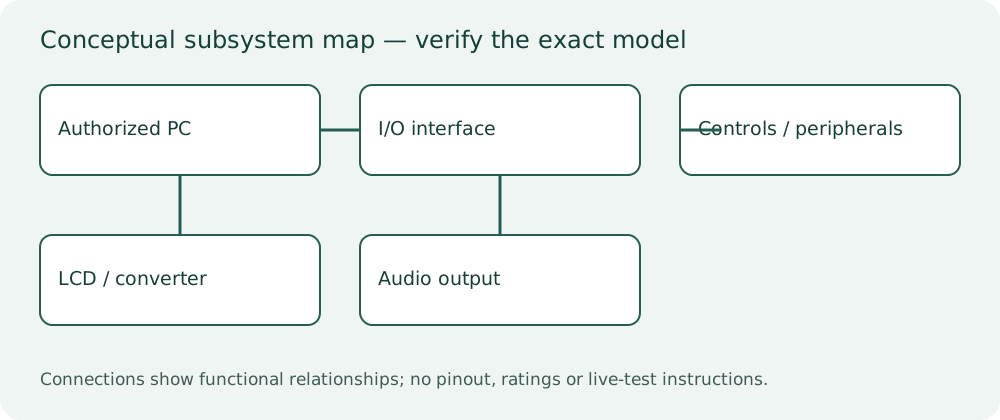
Original conceptual block diagram. Connector assignments, voltage limits and service procedures must come from the exact model manual.
Begin with the two free previews. Work through the mini courses, keep a repair-planning portfolio, then submit the capstone worksheet for qualified review. Quizzes record written learning only.
Modern Systems & Startup
Four focused lessons with original diagnostic cases, Q&A, checks and printable planning worksheets.
4 lessons • included in this full track and the complete program
Open mini course →View price & enrollControls, Peripherals & Audio
Four focused lessons with original diagnostic cases, Q&A, checks and printable planning worksheets.
4 lessons • included in this full track and the complete program
Open mini course →View price & enrollSoftware, Conversion & Recovery
Four focused lessons with original diagnostic cases, Q&A, checks and printable planning worksheets.
4 lessons • included in this full track and the complete program
Open mini course →View price & enrollOperator Service & Portfolio
Four focused lessons with original diagnostic cases, Q&A, checks and printable planning worksheets.
4 lessons • included in this full track and the complete program
Open mini course →View price & enrollFind an arcade lesson, symptom or question
Search titles and learner questions. Lesson access follows your existing mini-course, full-track or complete-program purchase.
- Free preview: Map a modern cabinet: PC, I/O and displayModern Systems & Startup • Free sample
- Free preview: Free preview: diagnose no signal without replacing partsModern Systems & Startup • Free sample
- PC startup, firmware and storage faultsModern Systems & Startup • Included lesson
- Cooling, dust and maintenance schedulingModern Systems & Startup • Included lesson
- USB encoders and input mappingControls, Peripherals & Audio • Included lesson
- Trackballs, spinners and calibrationControls, Peripherals & Audio • Included lesson
- Light guns, steering and specialized I/OControls, Peripherals & Audio • Included lesson
- Modern audio and peripheral fault isolationControls, Peripherals & Audio • Included lesson
- MAME dependencies and version recordsSoftware, Conversion & Recovery • Included lesson
- Legal modernization and reversible changesSoftware, Conversion & Recovery • Included lesson
- Backup, recovery and rollback planningSoftware, Conversion & Recovery • Included lesson
- Input latency, aspect ratio and acceptanceSoftware, Conversion & Recovery • Included lesson
- Operator diagnostics, audits and service bulletinsOperator Service & Portfolio • Included lesson
- Parts sourcing, compatibility and repair quotesOperator Service & Portfolio • Included lesson
- Preventive care and customer documentationOperator Service & Portfolio • Included lesson
- Modern cabinet capstone and service portfolioOperator Service & Portfolio • Included lesson
No matching lessons. Try a shorter symptom or circuit name.
Free preview: Map a modern cabinet: PC, I/O and display
Learning goal: Separate display operation from video source and boot status.
Modern cabinets often distribute functions across a computer, I/O board, display, audio and peripherals. A game can boot while controls fail, or a screen can show its own menu without receiving game video. Treat the cabinet as connected subsystems rather than one black box.
Inventory model and revision, authorized software version, interfaces and manufacturer documents. Record the sequence from power-on to attract mode and whether a screen is generated by the display or the computer. A model-specific service bulletin may change a test plan. Physical resemblance does not establish software interchangeability.
Diagnostic planning checklist
- Identify the actual assembly, not just the cabinet artwork.
- Record the applicable document and revision.
- Separate observation from inference.
- Define one discriminating next step within authorized competence.
- Preserve the original configuration and reversible changes.
- Verify the accepted repair scope and document remaining limitations.
Questions learners ask
Can I diagnose “map a modern cabinet: pc, i/o and display” from one photograph?
A photograph can document appearance, labels and some visible damage. It normally cannot establish circuit condition, timing, compatibility or electrical safety. Use it as evidence in a model-specific record, not a replacement-part verdict.
What should I write before replacing a part?
Separate display operation from video source and boot status. List the competing hypothesis, the observation that would discriminate it, exact compatibility evidence and the post-repair verification.
What is the repair tip that saves unnecessary purchases?
Inventory model and revision, authorized software version, interfaces and manufacturer documents. Record the sequence from power-on to attract mode and whether a screen is generated by the display or the computer. A model-specific service bulletin may change a test plan. Physical resemblance does not establish software interchangeability.
What if I am not trained for the next test?
Prepare the identity and symptom worksheet, leave hazardous equipment off and request the defined assessment from a qualified technician. Written theory does not establish safe practical competence.
Arcade service glossary
- Attract mode
- The demonstration shown while waiting for a player.
- Burn-in
- Persistent uneven phosphor wear in a CRT.
- Chassis
- The electronics assembly of a monitor; distinguish it from tube and frame.
- Checksum
- A calculated value used to compare stored data.
- Coin input
- The electrical credit request, distinct from mechanical coin acceptance.
- Convergence
- Alignment of color images in a color CRT.
- Daughterboard
- An additional board connected to a main logic assembly.
- Deflection
- The scanning system that positions a CRT image.
- DIP switch
- A physical bank of configuration switches.
- Edge connector
- A connector contacting pads on a board edge.
- ESD
- Electrostatic discharge that can damage electronics.
- I/O
- Input/output: interfaces to controls and peripherals.
- Isolation
- A specified electrical separation; not a guarantee of harmless equipment.
- JAMMA
- A cabinet/board interface convention; verify actual implementation and extras.
- Latency
- Delay between an input and its visible or audible effect.
- Logic probe
- A tool for observing suitable digital signal states within its ratings.
- Raster
- The scanned image area of a CRT.
- Reset
- A signal that establishes an initial system state.
- Ripple
- Variation superimposed on a supply level.
- ROM
- Read-only program or data storage.
- RAM
- Working memory that typically requires power to retain its data.
- Sync
- Timing information used to coordinate image scanning.
- Watchdog
- A system that can reset a machine when expected activity fails.
- Voltage drop
- A difference along a current-carrying path caused by impedance.
- Purity
- Correct beam landing on the intended color phosphor.
- Four-way restrictor
- A joystick gate intended to prevent diagonal directions.
- Rollback
- A documented route back to a known configuration.
- Acceptance matrix
- A written set of conditions for verifying agreed work.
Diagnostic case
A modern cabinet shows the monitor’s menu but not the game, while its I/O board has status lights.
Fictional training case; the observations are not measurements from your arcade cabinet.
Practice task / worksheet
Produce a one-page worksheet for “Map a modern cabinet: PC, I/O and display”. Record the equipment identity and document revision, three facts from the case, two competing causes, the safest next discriminating observation, the authorized work boundary and a measurable acceptance criterion. Explain why your observation would distinguish the causes. Do not perform internal work as part of this written exercise.
Printable diagnostic worksheet
- Model, chassis and revision
- _______________________________
- Symptom and when it occurs
- _______________________________
- Evidence versus assumptions
- _______________________________
- Three competing hypotheses
- _______________________________
- Documentation and qualified assessment required
- _______________________________
- Approved scope and verification criteria
- _______________________________
Check your reasoning
In this case, which decision is supported by the available evidence? A modern cabinet shows the monitor’s menu but not the game, while its I/O board has status lights.
Separate display operation from video source and boot status. The case does not provide enough evidence for a universal component diagnosis. Record an alternative cause and verify the authorized scope before changes.
References and further reading
Original written lessons and fictional diagnostic cases. Manufacturer service procedures must be obtained for the exact equipment; linked manuals are not resold as course downloads.
- Midway Pac-Man Parts and Operating Manual (December 1980), original manual scan
- Midway original manual and logic-troubleshooting archive: select exact title and revision
- Nintendo original operations manuals: select exact cabinet and board revision
- Wells-Gardner manufacturer service manuals, schematics and troubleshooting guides
- Ultimarc J-PAC manufacturer installation and video compatibility documentation
- Ultimarc I-PAC2 manufacturer control-interface documentation
- MAME project documentation: ROM, BIOS, device and disk-image set structure
- MAME project troubleshooting and software-use FAQ
- Raw Thrills manufacturer manuals and service bulletins
- Raw Thrills Drift conversion manual: manufacturer fault tables
Save to Pinterest